
Written by Mark Njecho
Mark writes about AI, business software, digital marketing and practical ways businesses can use technology to improve how they work.
Editorial note: The scenarios in this guide are illustrative examples designed to help readers evaluate workflows. Pricing, payment integrations and regulatory requirements can vary by provider and business, so verify the details that apply to your situation before making a purchase or implementation decision.
A practical guide to choosing and using property management software for landlords, property managers, real estate agencies and property businesses in Kenya.
⏱ 15 min read
Managing five rental units with a spreadsheet can feel perfectly reasonable.
Then you manage 20.
Then 50.
Suddenly, answering a simple question like “Did this tenant pay?” means checking an M-Pesa message, opening a spreadsheet, searching through WhatsApp and possibly asking someone else to confirm the payment.
And that’s when the problem becomes clear.
Your property portfolio has grown, but your management system hasn’t.
For many property businesses in Kenya, day-to-day operations are spread across spreadsheets, notebooks, receipts, bank records, M-Pesa messages, WhatsApp conversations, email and paper documents.
Each tool may work perfectly well on its own.
The problem is what happens when they all have to work together.
A tenant needs to be connected to a unit. That unit belongs to a property. The tenant has a lease. The lease has dates and rental terms. Payments need to be associated with the right tenant and billing period. Maintenance requests need to be connected to the property and tracked until they are completed.
When this information lives in different places, the business spends more time finding and reconciling information and less time managing the property.
That’s where real estate management software in Kenya comes in.
A property management system brings the important parts of the business into one connected environment: properties, units, tenants, leases, rent, payments, maintenance, documents and reporting.
But choosing software isn’t simply about finding the platform with the longest feature list.
The better question is:
What does your property business need to manage every day, and which parts of that process should the software handle for you?
In this guide, we’ll break down what real estate management software is, how it works, the features that matter, rent and M-Pesa payment tracking, tenant and lease management, maintenance workflows, reporting, software costs, custom versus ready-made systems, and what to consider before choosing a solution.
By the end, you’ll have a clearer framework for deciding whether your business needs a simple property management tool, a more comprehensive property management system, or a custom application built around your specific workflow.
Key takeaway: Property management software is most useful when it helps a growing property business replace disconnected information and repetitive manual work with clear, connected workflows.
- Landlords can use it to organise tenants, rent records, leases and maintenance.
- Property managers can use it to manage multiple properties and standardise recurring workflows.
- Real estate businesses can use connected systems to organise different stages of the customer and property journey.
- Growing portfolios often benefit from clearer reporting, permissions, documents and task ownership.
- Kenyan businesses should pay particular attention to payment workflows and how the system handles M-Pesa-related records and reconciliation.
Table of Contents
- What Is Real Estate Management Software?
- Why Property Businesses in Kenya Need Management Software
- How Property Management Software Works
- Key Features of Property Management Software
- Rent Collection and Payment Tracking
- Tenant Management
- Lease Management
- Property Maintenance Management
- Property Reporting and Financial Visibility
- M-Pesa and Digital Rent Collection
- How to Choose Real Estate Management Software in Kenya
- Before You Buy: Test the Software Against Your Real Business
- How Much Does Property Management Software Cost in Kenya?
- Custom vs Ready-Made Real Estate Software
- Frequently Asked Questions
- Sources & Further Reading
- Good Property Management Starts With Good Demand
- Conclusion
What Is Real Estate Management Software?
Real estate management software is a digital system that helps a property business manage the information and processes involved in operating real estate assets.
A system may bring together properties, buildings, units, tenants, owners, leases, rent, payments, maintenance, documents, expenses, users and reports.
A useful way to think about the software is a connected set of records rather than a collection of unrelated screens.
Imagine a landlord manages three apartment buildings with a total of 75 units. The business needs to know which units are occupied, who occupies each unit, what each tenant owes, when leases expire, which payments have been received, which repairs are pending and how much each property costs to operate.
A spreadsheet can store some of that information. The challenge comes when the same information has to be updated in multiple places.
A property management system attempts to create a single source of operational information. For property businesses that also work with land records, valuation or other property documentation, it is useful to understand the wider digital services provided by the State Department for Lands and Physical Planning.
A tenant record can be associated with a unit. The unit belongs to a property. The tenant has a lease. The lease has a rent amount and dates. Payments are recorded against the tenant or account. Maintenance requests are connected to the unit.
This connected structure is one of the most important differences between a proper Property Management System in Kenya and a collection of spreadsheets.
Real estate software is not the same as a property website
This distinction is worth making because the terms are sometimes mixed together.
A property website is primarily designed for public-facing activities such as displaying listings, providing information about developments or generating enquiries.
Property management software is primarily designed for internal operations.
A business may have both. A real estate agency could have a public website for property listings and a private management system for clients, properties, viewings, documents and transactions. If the business operates as an estate agency, the Estate Agents Registration Board (EARB) is a useful official reference for registration and licensing requirements.
Real estate management software vs accounting software
Accounting software records financial transactions and supports accounting processes. Property management software focuses on the operational relationship between properties, units, tenants and property activities.
There can be overlap. A good property system may contain financial reporting or integrate with accounting software, but it does not necessarily replace a full accounting platform.
Why Property Businesses in Kenya Need Management Software
The need for software usually appears when the existing way of working starts creating friction.
That friction can show up in surprisingly ordinary situations.
“Did this tenant pay?”
The payment may have been made, but the person responsible for updating the record has not done it yet. Someone checks an M-Pesa message. Another person checks a spreadsheet. A third person asks the tenant for confirmation.
“When does this lease expire?”
The information exists somewhere, but finding it requires opening documents one by one.
“Which repairs are still pending?”
Maintenance requests may be scattered across WhatsApp messages and phone calls. There is no clear queue or ownership.
“How much did this property make last month?”
The answer requires combining rent received, outstanding balances, expenses and vacancies manually.
None of these problems is particularly dramatic on its own. Together, they consume time and make it harder to run the business with confidence.
Key insight: Software becomes valuable when it reduces the number of places your team has to look before they can answer a business question.
Growth changes the management problem
A landlord with five tenants can often remember important details. A property manager handling hundreds of tenants cannot reasonably depend on memory.
As a portfolio grows, the business needs repeatable processes. New tenants should be onboarded consistently. Rent should be recorded consistently. Maintenance should follow a visible workflow. Reports should use the same definitions every month.
This is why Property Management Software for Property Managers often needs more structure than software designed for a single landlord.
How Property Management Software Works
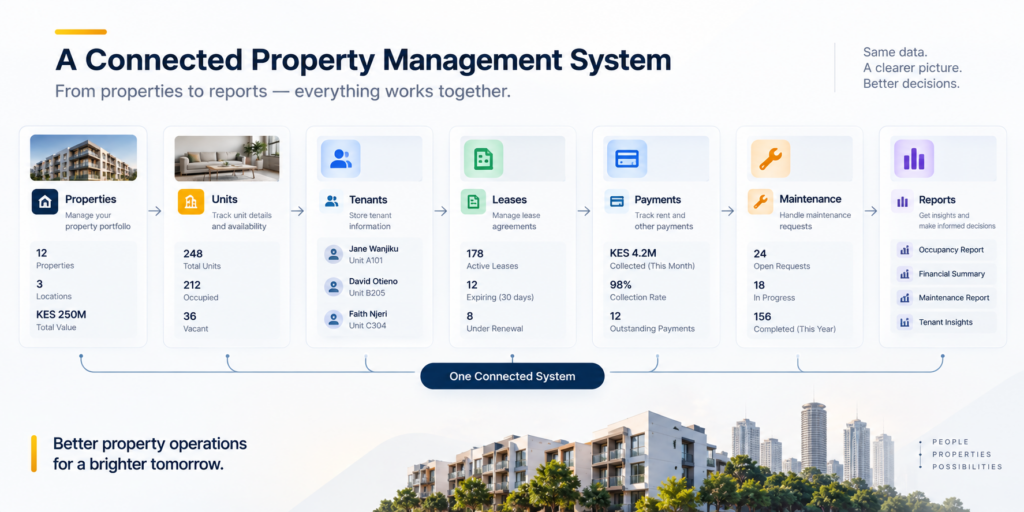
Most property management systems follow the same basic logic, even when their interfaces look different.
1. Properties are created
The business records its properties or buildings. A property might be an apartment block, commercial building, office property, student accommodation development, mixed-use building or a portfolio of individual rental houses.
2. Units are added
Each property can contain individual units. These might be apartments, offices, shops, houses, beds or other rentable spaces.
3. Tenants are connected to units
Tenant information is recorded and associated with the relevant unit. Depending on the system, this may include contact information, identification details, lease information and communication records.
4. Charges and payments are recorded
The system records what is expected and what has actually been received. This distinction matters because revenue expected is not the same thing as cash collected.
5. Leases and documents are managed
Important dates, agreements and supporting documents can be kept with the relevant tenant or property record.
6. Maintenance follows a workflow
A request can move from reported to assigned, in progress, completed or another status defined by the business.
7. Reports bring the information together
Managers can review occupancy, collections, outstanding balances, maintenance and other operational information without rebuilding the picture from scratch each time.
The exact workflow varies from one Real Estate Management System to another, so these processes should be treated as a framework rather than a universal software specification.
Key Features of Property Management Software
Feature lists can become overwhelming. The better question is not “How many features does this system have?” but “Which business problems do these features solve?”
| Feature | What it helps manage | Why it matters |
|---|---|---|
| Property management | Buildings, properties and units | Creates an organised portfolio structure |
| Tenant management | Tenant profiles and occupancy | Keeps important tenant information together |
| Rent tracking | Expected and received payments | Makes outstanding balances easier to identify |
| Lease management | Lease terms and dates | Reduces dependence on manual reminders |
| Maintenance | Repair requests and work status | Creates visibility over unresolved issues |
| Document management | Agreements and property records | Makes important documents easier to retrieve |
| Reporting | Portfolio and operational data | Supports regular management decisions |
| User permissions | Staff access and responsibilities | Helps control who can view or change information |
Property and unit management
The foundation of a property system is the portfolio structure.
You should be able to distinguish between the property, the building and the individual unit. This becomes particularly important when one organisation manages multiple developments.
Useful records can include property name, location, property type, unit number, unit type, occupancy status and other information relevant to the business.
Dashboard and portfolio overview
A dashboard should answer basic operational questions quickly.
How many units are occupied? Which balances are outstanding? Which maintenance requests are open? Which leases are approaching expiry?
The purpose of a dashboard is not to display every number available. It is to surface the numbers that require attention.
Rent Collection and Payment Tracking
Imagine this: You manage 30 occupied units. Every tenant is expected to pay KSh 20,000. That is KSh 600,000 expected for the month. But only KSh 540,000 has been received.
Now comes the real question: Who has not paid, how much do they owe, and which payments are still waiting to be reconciled?
Rent is usually one of the most important recurring processes in a rental property business, which makes Rent Collection Software in Kenya a common requirement.
But rent collection is broader than sending reminders.
Expected rent vs collected rent
A useful system should distinguish between what was supposed to be paid and what was actually received.
Consider a property with 30 occupied units. If every unit is expected to pay KSh 20,000 in a particular month, the expected rental amount is KSh 600,000. If only KSh 540,000 has been received, the system should make the difference visible.
That information becomes more useful when the outstanding amount can be traced to individual units and tenants.
Payment history
A tenant’s payment history can help answer questions such as:
- When was the most recent payment received?
- Which month did it cover?
- Was the payment partial or complete?
- Is there an outstanding balance?
- What payment reference is associated with the transaction?
Payment reminders
Depending on the software, reminders can be generated based on payment schedules, outstanding balances or other rules.
What matters is to treat reminders as part of a workflow rather than the entire collection process. A reminder should ideally connect to an accurate balance and payment record.
Tenant Management
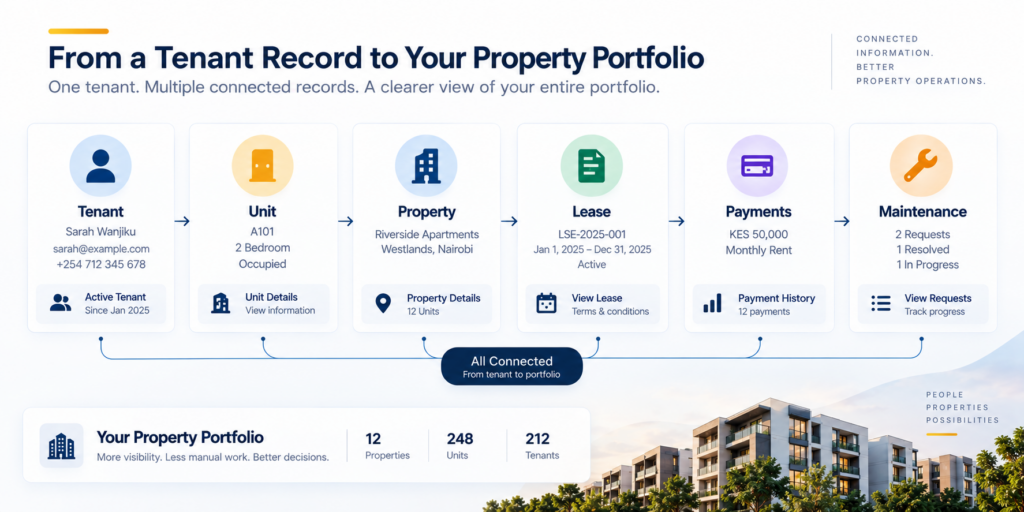
Here is a common test: a tenant calls about a maintenance issue. Can your team immediately see which unit they occupy, their lease details and previous maintenance requests?
Tenant Management Software gives a property business a structured way to maintain tenant information and connect it to the property they occupy.
A typical tenant record may include contact information, unit details, lease dates, rent information, payment history, maintenance history and relevant documents.
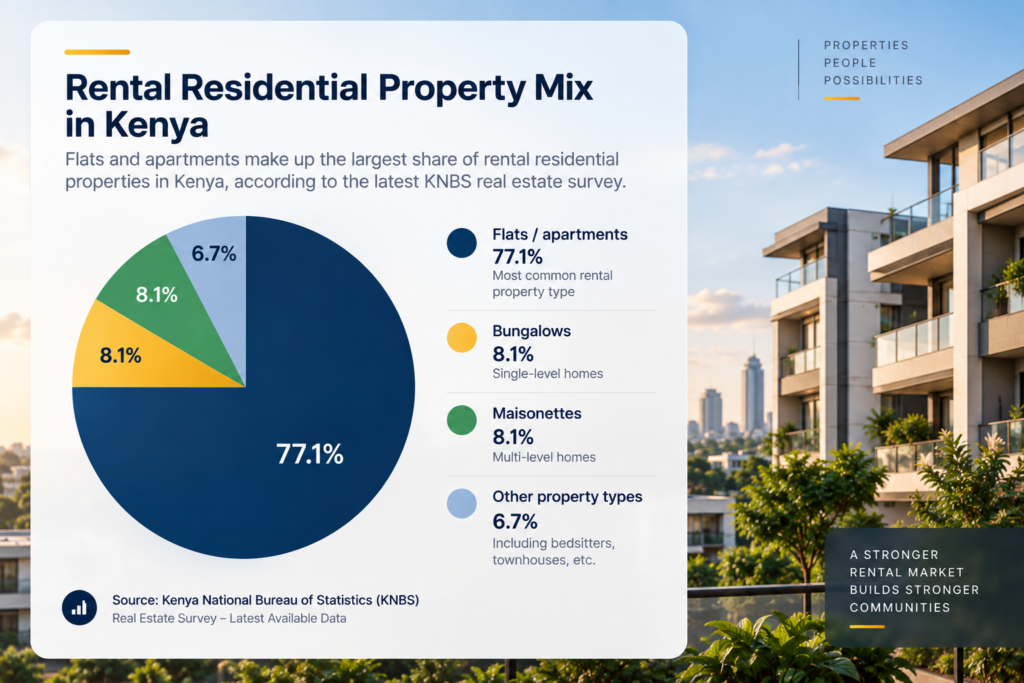
Source: Kenya National Bureau of Statistics, 2023/24 Real Estate Survey Report. This is the latest official rental-property type distribution identified in the available KNBS survey material; label it as the latest available structural profile rather than as 2026 survey data.
Why centralised tenant records matter
Imagine receiving a maintenance complaint from a tenant. If the system immediately shows the tenant’s unit, the property, their contact details and previous maintenance requests, the person handling the issue has useful context without searching through several channels.
This is especially valuable for property managers where the person receiving a request may not be the person who originally onboarded the tenant.
Lease Management
Consider a portfolio with 100 tenants. How do you know which leases expire in the next 30, 60 or 90 days without manually checking documents one by one?
For legal questions around tenancy agreements and property obligations, use Kenya Law as the authoritative starting point for current legislation and legal materials rather than relying on software documentation alone.
Leases contain information that can affect occupancy, revenue and tenant relationships. Yet lease information is often stored as a document that nobody looks at until there is a reason to.
Lease Management Software Kenya can bring important dates and terms into the operational workflow.
Useful lease information to track
- Lease start date
- Lease expiry date
- Rent amount
- Deposit information
- Renewal information
- Relevant notices or terms
- Associated documents
The exact fields depend on the business and its agreements. The important principle is that key information should be structured enough to search, report and act on.
Lease expiry visibility
A system can make upcoming lease expiries visible so that the property team can start the relevant conversation in advance.
This is more reliable than relying on someone to remember every date in a portfolio manually.
Property Maintenance Management
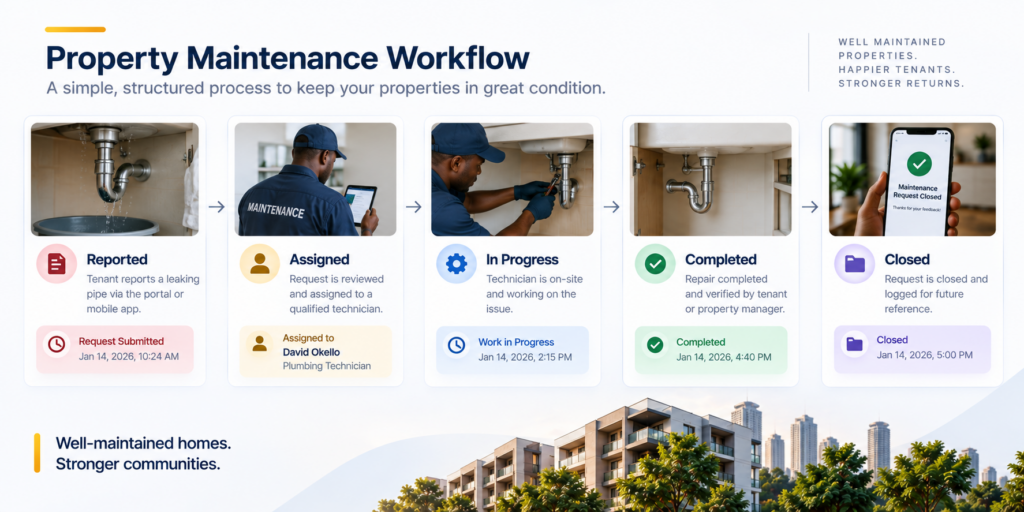
Picture the familiar scenario: a tenant reports a broken water pipe on WhatsApp. Three days later, someone asks, “Was that repair ever completed?”
Maintenance is one of the areas where a simple messaging system can quickly become difficult to manage.
A tenant sends a WhatsApp message. Someone forwards it to a caretaker. The caretaker calls a technician. The technician attends the property. Later, somebody asks whether the repair was completed.
Nothing is inherently wrong with WhatsApp. The problem is that the conversation is not necessarily a structured maintenance record.
A maintenance workflow
A Property Maintenance Software Kenya workflow might look like this:
- A tenant or staff member reports an issue.
- The request is associated with the relevant property and unit.
- The issue receives a status or priority.
- The responsible person or technician is assigned.
- The work is carried out.
- The request is marked completed after verification.
- Relevant costs or documents are recorded where appropriate.
This creates something important: accountability.
Instead of asking “What happened to that repair?”, a manager can look at the request and see its current status.
Property Reporting and Financial Visibility
Bar graph: Example property portfolio performance
Use an explicitly labelled illustrative chart comparing expected rent, collected rent and outstanding rent across three fictional properties. This gives readers a visual model for how portfolio reporting can work without presenting invented business results as real data.
Label all figures as illustrative. Do not attribute the example values to Kenya-wide market data.
Now imagine your manager asks: “How much did Property A collect last month?” Can you answer in 30 seconds, or does someone need to combine several records first?
Reports should help answer questions, not simply create impressive-looking charts.
A property business might need to know:
- How much rent was expected?
- How much was collected?
- How much remains outstanding?
- Which properties have vacancies?
- Which units are generating outstanding balances?
- How many maintenance requests are open?
- Which leases are approaching expiry?
- How are different properties performing against the business’s own targets?
Reports should be based on clean data
This is easy to overlook.
A dashboard cannot compensate for poor records. If payments are entered inconsistently, tenant records are duplicated or vacancies are not updated, the resulting report can look precise while still being wrong.
Key insight: Better reporting starts with better data capture. The dashboard is only as reliable as the records underneath it.
M-Pesa and Digital Rent Collection
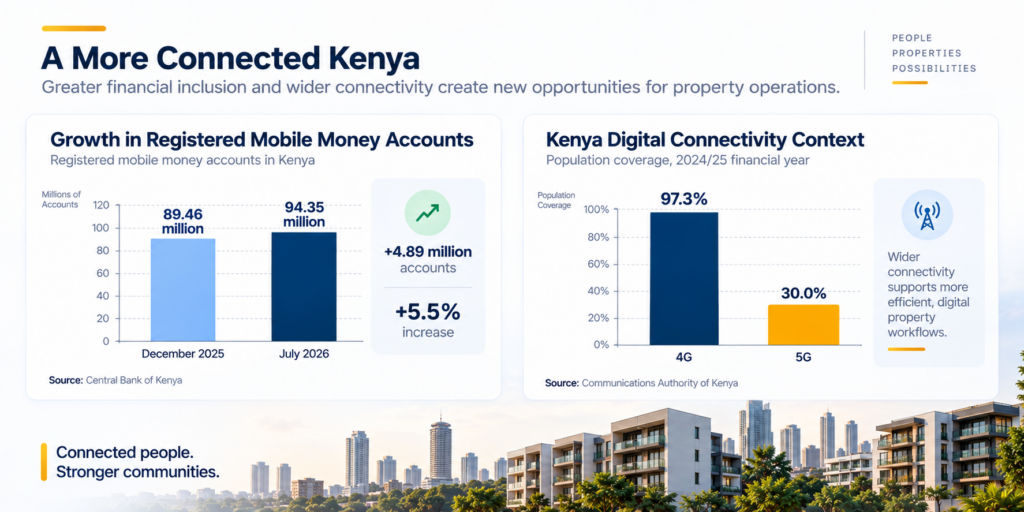
Source: Communications Authority of Kenya, 2024/2025 sector statistics. These are population coverage figures, not property-management adoption rates.
For a Kenyan property business, payment workflows deserve particular attention. The Central Bank of Kenya’s National Payments System information provides useful background on retail payments and mobile money in Kenya. As of July 2026, the Central Bank of Kenya reported 94.35 million registered mobile money accounts, illustrating the scale of the payment environment in which many Kenyan businesses operate.
M-Pesa Rent Collection Software can refer to several different things, so it is important to understand what a provider actually supports.
A system might simply allow staff to record an M-Pesa transaction manually. Another system might integrate with a payment process so that payment information can be captured and matched to the appropriate account.
Questions to ask about payment integration
- Can payments be associated with specific tenants or units?
- Can the system record payment references?
- How are partial payments handled?
- How are unidentified payments handled?
- Can staff reconcile received payments against expected rent?
- Does the provider support the specific M-Pesa workflow your business uses?
- What happens when a payment fails or needs correction?
For businesses considering direct M-Pesa integration, Safaricom’s Daraja developer portal documents the APIs used to connect web and mobile applications with M-Pesa services.
Do not assume that a product labelled “M-Pesa compatible” supports every possible payment workflow. Ask for a demonstration of the exact process your business needs.
How to Choose Real Estate Management Software in Kenya
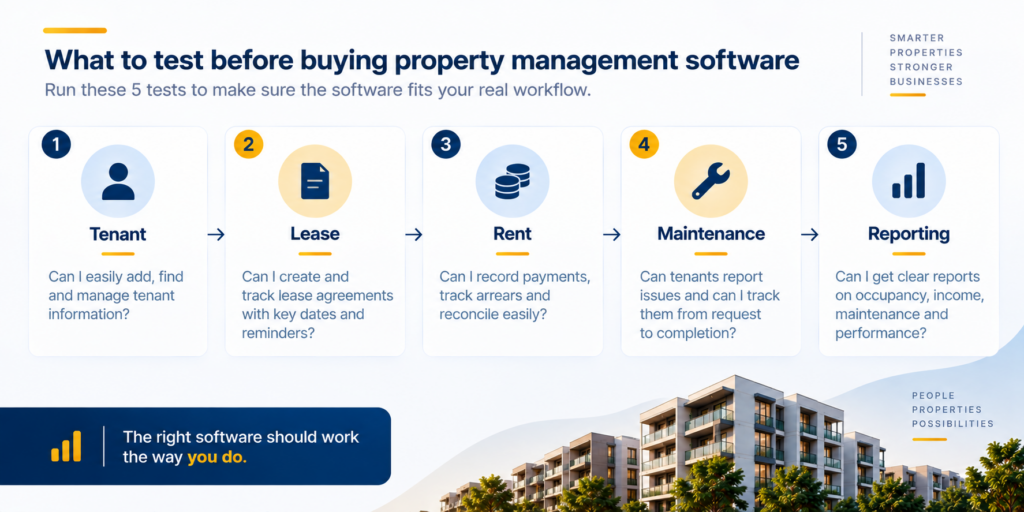
Choosing software should begin with your workflow, not the vendor’s feature list. If your business handles personal information such as tenant names, phone numbers, identification details or payment records, review the Office of the Data Protection Commissioner’s data protection framework as part of your due diligence.
If you are comparing providers beyond the property-management category, see our guide to software companies in Kenya for the wider buying landscape.
1. Start with your current process
Write down how a tenant moves through your business today.
How do you advertise or allocate a unit? How do you onboard the tenant? How is the lease stored? How is rent recorded? How are arrears identified? How are maintenance requests received? How are reports prepared?
This process map gives you something concrete against which to evaluate software.
2. Identify the biggest sources of manual work
Do not try to automate everything at once.
If rent reconciliation takes several hours every week, start there. If maintenance requests are the biggest problem, prioritise maintenance. If management cannot quickly see portfolio performance, prioritise reporting.
3. Match the software to your portfolio
A small landlord and a professional property management company may have very different requirements.
Consider the number of properties, units, tenants, staff members and external users who will interact with the system.
4. Check the payment workflow
For a Kenyan rental business, payment handling should be demonstrated rather than assumed.
9. Test with real scenarios
A demo using generic information can make almost any platform look good.
Instead, ask the provider to demonstrate your actual scenarios.
For example: “Show me what happens when a tenant pays half the rent, then pays the balance later.” Or: “Show me how a maintenance request moves from report to completion.”
10. Calculate the full cost
Do not look only at the subscription fee. Consider setup, migration, integrations, additional users, payment fees, customisation, training and ongoing support where applicable.
| Question | What to look for |
|---|---|
| Does it fit my workflow? | Property, tenant, payment and maintenance processes match how you actually operate. |
| Can it grow with us? | Support for additional properties, units, users and reporting needs. |
| Can we control access? | User roles and permissions appropriate for different staff. |
| Can we access our data? | Clear data export and ownership policies. |
| Does it support our payments? | A payment workflow that matches the business’s actual collection process. |
| Is it secure? | Reasonable controls for accounts, data and documents. |
| Is support available? | Clear support channels and service expectations. |
Before You Buy: Test the Software Against Your Real Business
A polished demo can make almost any software look impressive. Your job as the buyer is to find out whether it will still make sense on an ordinary Tuesday when a tenant has paid the wrong amount, a repair is overdue and your manager wants a report before lunch.
Instead of asking only, “What features do you have?”, give the provider a few real situations from your business and ask them to walk you through each one.
| Real-world situation | What to test |
|---|---|
| A tenant makes a partial rent payment | Can the payment be recorded correctly and does the outstanding balance update? |
| A tenant moves from one unit to another | Can the tenant history, lease and unit records remain connected without creating duplicate information? |
| A maintenance issue is reported | Can the request be assigned, tracked and closed with a clear history? |
| A lease is approaching expiry | Can the team identify the relevant tenants early enough to act? |
| Management asks for a property report | Can the report be produced from the system without rebuilding it manually in another spreadsheet? |
This changes the buying conversation. You are no longer comparing feature lists; you are testing whether the product can handle the work your business actually performs.
It also gives you a clearer way to compare different providers. If one system looks attractive on paper but requires workarounds for your most common scenarios, that matters. If another has fewer headline features but handles your core workflow cleanly, that matters too.
Once you have a shortlist, our guide to choosing a software company in Kenya provides a broader framework for evaluating a software partner.
A useful buying principle: Compare software against the work your team actually performs, not against the number of features shown in a demo. A smaller system that fits the workflow can be more useful than a larger platform that creates workarounds.
Is It Time to Move Beyond Spreadsheets?
You do not need a certain number of units before software becomes worthwhile. A better signal is operational friction.
| If this is happening… | It may be time to evaluate… |
|---|---|
| Your team repeatedly reconciles payments across messages and spreadsheets. | Rent and payment tracking software. |
| Staff cannot quickly see who occupies which unit or what is outstanding. | Connected property and tenant records. |
| Maintenance requests disappear into conversations. | A structured maintenance workflow. |
| Management reports require manual consolidation every month. | Centralised reporting and dashboards. |
| Your workflow is too specialised for the systems you have tried. | A configurable or custom application. |
The point is not to replace every existing tool. It is to identify the part of the operation where disconnected information is creating enough friction to justify a better system.
How Much Does Property Management Software Cost in Kenya?
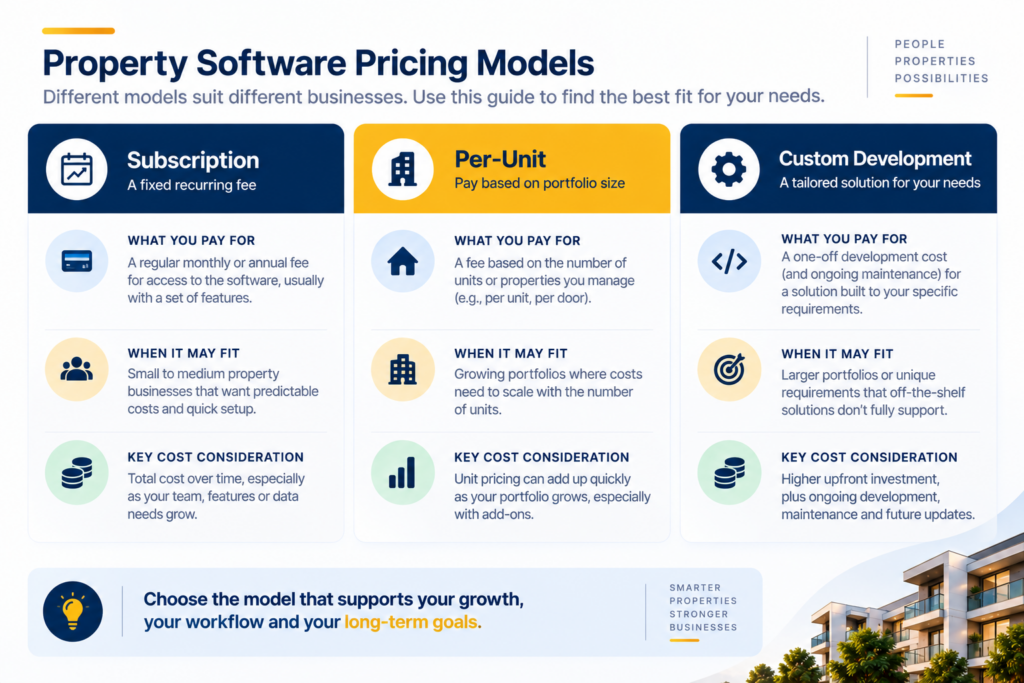
There is no single price for Property Management Software Kenya Price because software products are priced using different models.
If you are considering a custom build, see our guide to custom software cost in Kenya for a deeper look at what drives development budgets.
Some providers charge a monthly subscription. Others may price by number of units, properties, users or features. Custom software is normally priced according to the scope of the project.
Subscription pricing
Per-unit pricing
Some systems structure pricing around the number of units managed. This can make sense for property businesses where portfolio size is the main driver of system usage.
Custom software pricing
Custom property management software is harder to price from a generic feature list because the cost depends on what is being built.
A simple internal dashboard is fundamentally different from a multi-property platform with tenant portals, payment integrations, permissions, reporting, notifications and external integrations.
Look beyond the headline price
When comparing software, calculate the total cost of ownership.
- Subscription or licence cost
- Setup and onboarding
- Data migration
- Additional users
- Integrations
- Payment-related costs
- Custom development
- Training
- Support
A cheaper system that requires extensive manual work may not be cheaper in practice. Conversely, a larger platform may contain capabilities your business will never use.
Custom vs Ready-Made Real Estate Software
This is one of the most important decisions a growing property business can make.
A ready-made platform gives you an existing product designed around a general set of property management requirements. Custom software is built around the specific workflows of one business.
| Consideration | Ready-made software | Custom software |
|---|---|---|
| Starting point | Existing product and workflows | Business-specific requirements |
| Speed to start | Usually quicker to begin | Requires design and build work |
| Customisation | Depends on available configuration | Built around defined requirements |
| Process fit | Business adapts to the product to some extent | Product can be designed around the business |
| Upfront work | Usually lower implementation effort | Requires requirements, design, testing and deployment |
| Maintenance | Provider maintains the product | Ongoing technical ownership must be planned |
When ready-made software may make sense
If your needs closely match common property management workflows, a ready-made system may provide a practical starting point.
When custom software may make sense
Custom software becomes more relevant when your processes are unusual, your business has specialised workflows, or existing products force your team into workarounds.
For example, a property company might manage a combination of rentals, sales, maintenance teams, owner reporting and internal approvals. If no existing product handles the workflow cleanly, building a system around those processes may be worth considering.
The decision should be based on requirements rather than the assumption that custom is automatically better.
Frequently Asked Questions
What is real estate management software in Kenya?
Real estate management software in Kenya is software used to organise and manage property operations such as properties, units, tenants, rent, payments, leases, maintenance and reporting. The exact features differ between providers.
What is property management software?
Property management software is a system that helps landlords and property managers organise the operational information associated with rental properties. Depending on the product, it may include tenant management, rent tracking, maintenance, lease management and reporting.
Can landlords use property management software?
Yes. Landlords can use software to manage tenants, rent, payment records, leases, maintenance and property documents. The appropriate level of functionality depends on the size and complexity of the portfolio.
Is there property management software for property managers?
Yes. Property managers can use systems designed to handle multiple properties, tenants and workflows. When comparing options, look particularly at portfolio management, user permissions, reporting, maintenance and owner-related reporting requirements.
Can property management software collect rent through M-Pesa?
Some systems support M-Pesa-related payment workflows, but the exact capabilities vary. Ask the provider whether payments can be automatically or manually matched to tenants, how references are handled and how reconciliation works.
How does tenant management software help landlords?
It gives landlords a structured place to maintain tenant information, unit details, leases, payment history, maintenance records and relevant documents instead of relying on disconnected files and conversations.
What should a property management system include?
Common capabilities include property and unit management, tenant records, rent tracking, payment records, lease management, maintenance workflows, documents, reporting and user permissions. Payment integrations and communication tools may also be relevant.
How much does property management software cost in Kenya?
Pricing varies by provider and pricing model. Some products use subscriptions, per-unit pricing or per-user pricing, while custom software is normally priced according to scope. Compare the full cost rather than only the advertised subscription.
What is custom property management software in Kenya?
Custom property management software is a system built around the specific processes and requirements of a particular property business rather than using a standard product with predefined workflows.
When should a landlord move from spreadsheets to software?
There is no fixed number of units. A practical signal is when spreadsheets, messages and manual processes make it difficult to know the current state of rent, tenants, leases or maintenance. If staff spend significant time reconciling information manually, it may be worth evaluating dedicated software.
Sources & Further Reading
This guide combines practical property-management scenarios with official Kenyan information relevant to software, digital business and personal-data handling. The examples are illustrative; businesses should verify provider-specific features and the rules that apply to their own operations.
- Office of the Data Protection Commissioner (Kenya) — official information on data protection, data controllers, data processors and compliance.
- ODPC: Data Protection Laws in Kenya — the regulatory framework and related data-protection regulations.
- Ministry of Information, Communications and the Digital Economy — official information on Kenya’s ICT and digital-economy functions, including software development and data protection policy.
- Central Bank of Kenya: National Payments System — background on payment systems, mobile money and payment-service oversight in Kenya.
- Safaricom Daraja Developer Portal — official documentation for integrating M-Pesa APIs with web and mobile applications.
- Estate Agents Registration Board (EARB) — official information on estate-agency registration, licensing and professional regulation in Kenya.
- State Department for Lands and Physical Planning — official information and services relating to land administration, registration, planning and property-related public services.
- Kenya Law — official access point for Kenyan legislation and legal materials relevant to property and tenancy matters.
Good Property Management Starts With Good Demand
A well-organised property operation still needs a steady flow of people discovering the business, trusting it and taking the next step. That is where the buyer journey connects with the systems discussed throughout this guide.
A prospective tenant, buyer, investor or property owner may first find a business through search, social media, a referral, a listing or useful content. They are not necessarily ready to enquire immediately. They are learning, comparing and deciding whether the business looks credible enough to contact.
The video below explores five practical rules for building a stronger real estate marketing foundation: the mistakes that can hold growth back, why visibility matters, how to create a more consistent marketing system, and the role of content and branding in turning attention into enquiries.
As you watch, consider your own journey from visibility → trust → enquiry → conversion → relationship. Where do prospects discover you? What do they learn before contacting you? How quickly does the business respond? And once they become customers, what systems help you deliver what was promised?
Marketing creates the opportunity. Good sales and follow-up move the opportunity forward. Good operational systems help the business deliver consistently after the customer says yes. Thinking about those stages together gives you a more complete view of what software should support.
For a broader real-estate workflow—from leads and properties to clients and operations—see Your Real Estate Business Runs on More Than Listings.
Ready to Evaluate Your Options?
Start with the workflow you need to improve. Define the problem, test the requirements and compare the approach that best fits your property business.Explore Your Options
Conclusion
Managing property becomes harder as the portfolio grows because the information, transactions and decisions grow with it.
The right software is not necessarily the platform with the longest feature list. It is the system that fits the way the property business actually operates, keeps important information connected, and makes recurring work easier to manage.
Start with the workflow. Identify where information gets lost, where work is repeated and where decisions are slowed down. Then choose the technology that solves that problem without creating unnecessary complexity.