

Planning custom software? This guide explains what affects the price, what Kenyan businesses should budget for, and how to compare software quotations without comparing numbers in isolation.
⏱ 18 min read
If you are still comparing providers, start with our guide to software companies in Kenya. Once you have a shortlist, our practical guide on how to choose a software company in Kenya can help you evaluate experience, communication, pricing, support, and long-term fit before requesting a final quotation.
Short answer: Custom software in Kenya can range from roughly KES 300,000 for a focused MVP or internal tool to KES 8 million or more for a complex ERP, SaaS or enterprise platform. These are indicative planning ranges, not fixed market prices. The final budget depends on scope, workflows, users, integrations, platform requirements, data, security, testing and support.
Introduction
The question sounds simple: how much does custom software cost in Kenya? The honest answer is that there is no single price tag. A focused internal tool, a customer portal, a mobile application, and an enterprise platform can all be called custom software, yet they can require very different amounts of design, development, testing, infrastructure, and support.

Key takeaway: Custom software pricing is driven by scope and complexity, not by the label “custom software.” Use published figures as planning ranges, then get a detailed estimate based on your actual workflows.
The short answer is that custom software in Kenya can range from a few hundred thousand shillings for a focused MVP or internal tool to several million shillings for a complex ERP, SaaS platform, or enterprise system. Current Kenyan pricing guides show wide indicative ranges, which is exactly why businesses should treat published figures as planning bands rather than fixed market prices.
A recent 2026 Kenyan guide, for example, places focused internal tools and early MVPs around KES 300,000–900,000, custom business systems around KES 800,000–2.5 million, customer or member portals around KES 700,000–3 million, mobile applications with backend and integrations around KES 900,000–3.5 million, and complex ERP, multi-tenant SaaS, or enterprise platforms around KES 2.5 million–8 million or more. Other providers publish different starting points, so the figures should be used to frame a conversation, not to promise a final quote.
The biggest lesson is simple: do not budget from the software category alone. Budget from the scope. A CRM with five screens and basic contacts is not the same project as a CRM with lead scoring, approval workflows, WhatsApp messaging, payments, reporting, mobile access, audit trails, and several integrations.
Table of Contents
- Introduction
- Table of Contents
- What Actually Determines Custom Software Cost?
- How Scope Changes Your Software Budget
- How Users, Roles and Permissions Affect Cost
- Why Complex Workflows Increase Development Cost
- How UI and UX Design Affect Software Pricing
- Web, Mobile or Both: How Platform Choice Affects Cost
- How Integrations Affect Custom Software Pricing
- Data Migration and Legacy Systems
- Security, Privacy and Compliance Costs
- Testing and Quality Assurance
- Hosting and Infrastructure Costs
- Post-Launch Support and Maintenance
- Custom Software Cost Ranges in Kenya
- How Much Can Different Types of Software Cost?
- What Makes a Custom Software Project More Expensive?
- The Hidden Costs of Custom Software
- How Software Companies Calculate Their Prices
- Why Two Software Companies Can Give Very Different Quotes
- How to Reduce Software Costs Without Cutting Quality
- Custom Software vs Off-the-Shelf Software
- Is Custom Software Worth the Investment?
- A Simple Custom Software Cost Calculator
- How to Create a Realistic Software Project Budget
- What a Professional Software Quotation Should Include
- Choosing the Right Way to Build Your Software
- Frequently Asked Questions About Software Costs in Kenya
- How to Compare Software Quotations Properly
- A Practical Decision Framework Before You Approve the Budget
- Conclusion
What Actually Determines Custom Software Cost?
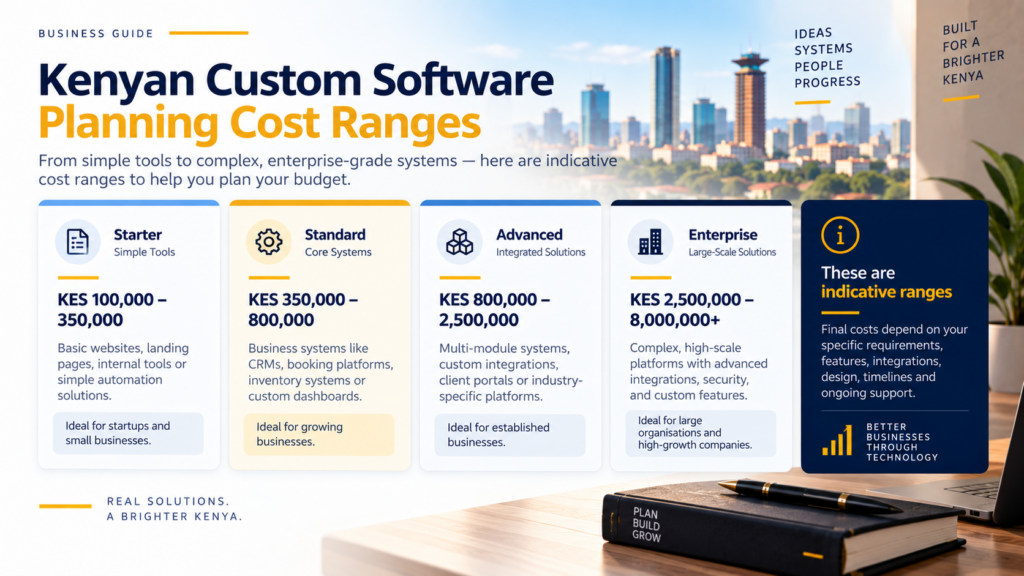
The biggest mistake buyers make is treating software as a collection of screens. Screens are visible, but much of the work sits underneath them. A professional development team has to understand business rules, user permissions, data structures, integrations, error handling, testing, security, deployment, and the operational reality behind each feature.
| Cost Driver | What Increases Cost | Budget Question |
|---|---|---|
| Scope | More modules and workflows | What must exist at launch? |
| Users | More roles and permissions | Who needs access to what? |
| Integrations | More external systems and failure cases | Which systems must connect? |
| Platform | Web + Android + iOS | What devices are essential? |
| Data | Large or messy legacy datasets | What must be migrated? |
| Support | High response expectations and continuous changes | What happens after launch? |
How Scope Changes Your Software Budget
Scope is usually the starting point. Scope describes what the software must do and, just as importantly, what it does not need to do yet. A focused first release can be affordable when it concentrates on the workflows that create the most value.
A useful way to think about scope is to separate must-have functionality from everything that would be nice to have later. A business might initially need customer registration, a sales pipeline, follow-up reminders and a manager dashboard. It may also imagine WhatsApp automation, advanced forecasting, mobile apps, document management, loyalty programmes and artificial intelligence. All of those ideas may be valuable, but putting them into the first release changes the project from a focused application into a much larger product. A disciplined scope keeps the first investment connected to the most important business outcome and gives the team a clearer basis for a software quotation.
How Users, Roles and Permissions Affect Cost
The number of users matters, but the number of user types can matter even more. A system used only by administrators is usually simpler than one used by administrators, managers, finance staff, field officers, customers, suppliers, and external partners.
User complexity can also appear in places buyers do not immediately notice. Every role has to be considered when the application is designed, tested and maintained. A customer may create a request, an employee may process it, a manager may approve it, and finance may reconcile the payment. If the application has multiple branches, each role may also need access to information for only one location. These rules are valuable because they protect information and reflect how the business operates, but they also create more scenarios for the development team to design and test. Defining roles early therefore helps control both cost and risk.
Why Complex Workflows Increase Development Cost
Complex workflows increase cost because software has to make decisions. Consider a simple booking system: choose a service, select a time, submit a booking. Now add staff availability, different branches, deposits, cancellations, rescheduling, approval, reminders, refunds, customer accounts, and reporting. The visible booking screen may still look simple, but the rules behind it are much more involved.
How UI and UX Design Affect Software Pricing
Design affects cost because software has to be understandable as well as functional. A basic internal tool may need a practical interface with standard components. A customer-facing platform may need a stronger user experience, responsive layouts, onboarding, accessibility considerations, polished interactions, and multiple device sizes.
Web, Mobile or Both: How Platform Choice Affects Cost
Web, Android, iOS, or a combination? The platform decision can change the budget significantly. A responsive web application may be enough for office teams who work from laptops. A field operation may need a mobile application with camera access, GPS, push notifications, offline data capture, and background synchronisation.
Platform choice should be based on how people actually work. If employees spend most of their time at desks, a responsive web application may provide everything they need without the additional work of separate mobile applications. If field employees need to capture information while travelling, a mobile-first experience may be more important. Businesses should also consider whether customers use phones, tablets or computers, and whether the application needs device capabilities such as a camera, location services, notifications or offline access. Choosing the simplest platform that supports the real workflow can prevent unnecessary development expense without compromising usability.
How Integrations Affect Custom Software Pricing
Integrations are a major cost driver in Kenyan software projects. Businesses may need M-Pesa, banks, SMS providers, email services, accounting software, CRMs, maps, identity services, e-commerce systems, or KRA eTIMS connections. Each integration has technical and operational requirements.
Data Migration and Legacy Systems
Data migration is easy to underestimate. Many businesses have years of customer records, spreadsheets, invoices, product lists, employee information, or historical transactions. Moving that information into a new system is not always a simple import.
Security, Privacy and Compliance Costs
Security is another cost factor, particularly when software handles customer, employee, financial, health, education, or other sensitive information. Security can involve authentication, password policies, role-based permissions, encryption, audit logs, backups, monitoring, secure development practices, and incident planning. Businesses handling personal information should also review ODPC guidance on data-subject rights when defining privacy, access and data-handling requirements.
Testing and Quality Assurance
Testing is one of the least visible parts of software development and one of the easiest to underbudget. A feature is not finished simply because it works once on a developer’s computer.
Hosting and Infrastructure Costs
Hosting and infrastructure can create ongoing costs after development ends. Depending on the application, you may pay for cloud servers, databases, storage, backups, monitoring, email delivery, SMS, payment services, domains, certificates, file storage, or other third-party services.
Post-Launch Support and Maintenance
Post-launch support is part of the real cost of software ownership. Even a well-tested system may require bug fixes, security updates, dependency upgrades, performance improvements, monitoring, user support, and new features.
Custom Software Cost Ranges in Kenya
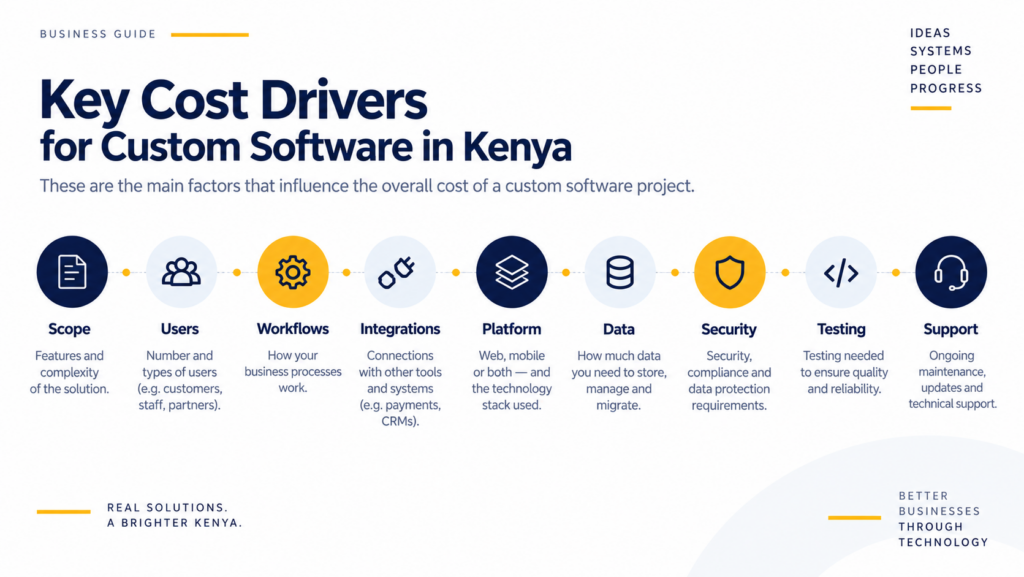
Published Kenyan pricing varies considerably, which is why businesses should treat online figures as indicative planning ranges. Current 2026 examples include focused MVP or internal-tool work in the hundreds of thousands of shillings, standard business systems in the high hundreds of thousands to low millions, and complex enterprise systems reaching several million shillings or more.
| Project Type | Indicative Planning Range | Typical Complexity |
|---|---|---|
| Discovery / clickable prototype | KES 100,000–350,000 | Requirements, workflows, prototype |
| Focused internal tool / MVP | KES 300,000–900,000 | Limited users and core workflows |
| Custom business system | KES 800,000–2.5 million | Multiple workflows, roles, reporting |
| Customer / member portal | KES 700,000–3 million | Accounts, secure access, customer workflows |
| Mobile app + backend + integrations | KES 900,000–3.5 million | Mobile experience, backend, APIs |
| ERP / SaaS / enterprise platform | KES 2.5–8 million+ | Complex operations, integrations, scale |
How These Kenyan Pricing Ranges Should Be Used
There is no official Kenyan tariff for custom software. The figures in this article are planning bands compiled from current Kenyan software providers and should not be treated as a market-wide price list. For example, Zama’s 2026 pricing guide publishes ranges from KES 300,000–900,000 for focused internal tools or simple MVPs through KES 2.5–8 million or more for ERP, multi-tenant SaaS and enterprise platforms. Statum publishes different starting points, including KES 150,000+ for an MVP, KES 500,000+ for a custom business system or ERP, and KES 1 million+ for enterprise integration or fintech work. The difference is a useful reminder: published prices describe particular scopes, not a universal market rate.
How Much Can Different Types of Software Cost?
A useful way to budget is to compare the type of system you are considering. The categories below are not fixed price lists. They are ways to think about relative complexity.
What Makes a Custom Software Project More Expensive?
Some requirements consistently push a project toward a higher budget. The first is breadth. More modules mean more workflows, interfaces, permissions, tests, and data relationships.
The fifth is speed. If a business needs a large project delivered unusually quickly, the provider may need more people working in parallel. That can increase the software development hourly rates or the total project budget.
The Hidden Costs of Custom Software
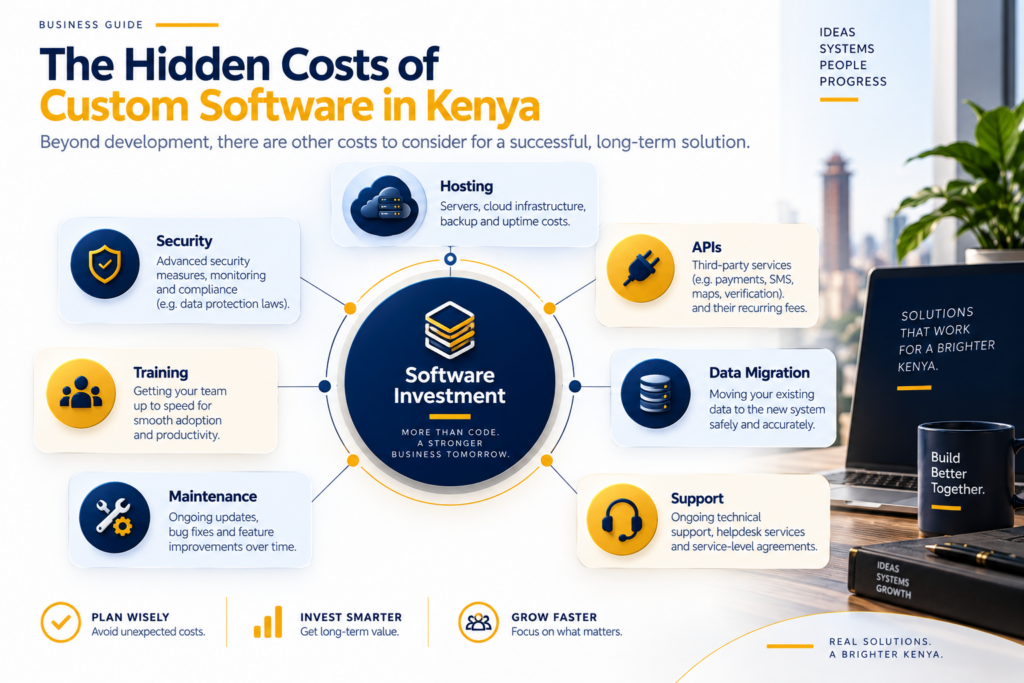
The development quote is not always the full cost of ownership. Hidden costs are not necessarily dishonest charges; they are often expenses that were simply outside the original scope.
Another cost that deserves attention is the cost of change itself. A business may discover after launch that a report needs another field, a customer needs a new status, or an approval process works differently in practice. These changes are normal, especially when users are seeing the software for the first time. The answer is not to eliminate change; it is to plan for it. A sensible budget can reserve money for post-launch improvements, while a clear change-control process can distinguish a small adjustment from a genuinely new feature. That keeps expectations realistic for both the buyer and the development team.
Hosting is one example. Third-party APIs are another. SMS, email delivery, payment processing, maps, file storage, analytics, app-store accounts, domain registration, and other services may have recurring fees.
Training can also be overlooked. If a system changes how employees work, the business may need onboarding sessions, documentation, user guides, internal champions, or temporary support during adoption.
Data cleanup can become a separate project when legacy information is inconsistent. Security work can grow if the system handles sensitive information. Additional testing may be needed when a project expands to more devices, branches, or user roles.
Future changes are another cost. No first release captures every idea. Budgeting a small amount for post-launch improvements can be healthier than trying to build every possible feature before the first user ever touches the system.
How Software Companies Calculate Their Prices
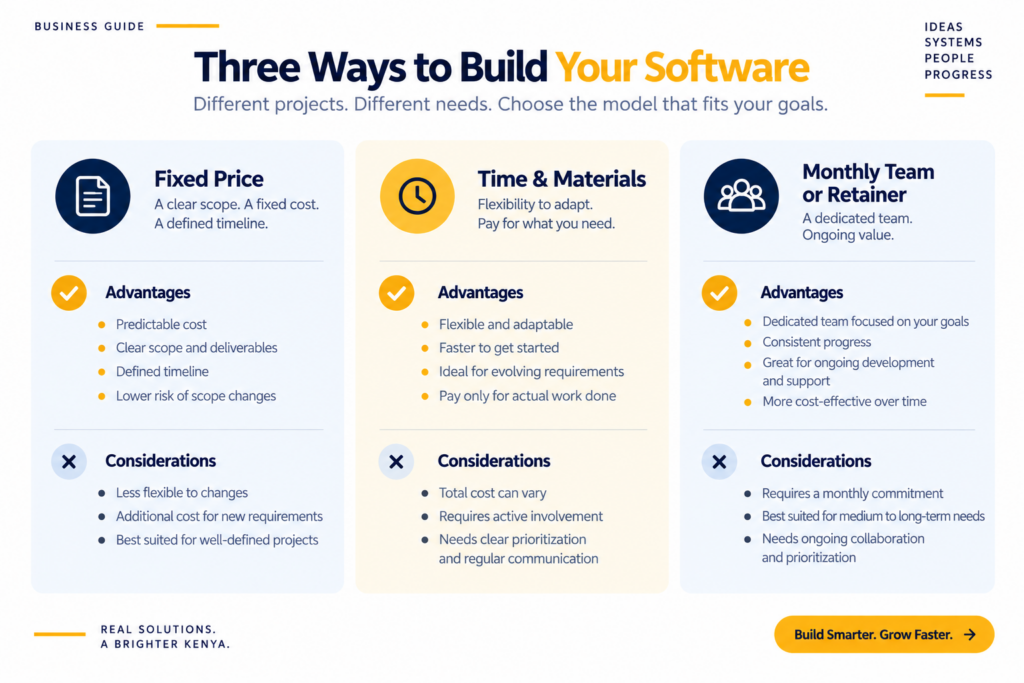
There are several common software development payment models in Kenya. The right one depends on how clearly the project can be defined and how likely the requirements are to change.
Fixed-price development works best when the first release has a stable scope. The provider estimates the work, agrees on deliverables, and usually links payments to milestones. The advantage is budget predictability. The limitation is that changes outside the agreed scope may require change requests or revised pricing.
Time and materials means the business pays for the development time and resources used. This can work well when the product will evolve through testing and feedback. It requires trust, transparent reporting, prioritised tasks, and a clear way to control monthly spending.
A dedicated team or monthly engagement can suit a product that will continue to evolve over several months. Instead of buying one fixed project, the business pays for an agreed team capacity and decides which work should be prioritised.
A retainer or service-level agreement is more commonly used after launch for maintenance, fixes, monitoring, support, and smaller improvements. It can make support more predictable because both sides know what level of service is expected.
| Model | Best For | Main Consideration |
|---|---|---|
| Fixed price | Stable, clearly defined first release | Changes outside scope may cost extra |
| Time and materials | Products that evolve through feedback | Needs transparent reporting and prioritisation |
| Dedicated team / monthly | Longer-term product development | Requires ongoing product ownership |
| Retainer / SLA | Maintenance, support, fixes | Clarify response times and included work |
Why Two Software Companies Can Give Very Different Quotes
Two companies can quote very different prices for the same project because they may not actually be quoting the same project. One proposal may include UX design, testing, deployment, training, source-code handover, documentation, and three months of support. Another may include only development.
Team structure also matters. A solo developer, a small agency, and a larger product team have different costs and capabilities. None is automatically the right choice. The question is whether the team structure matches the risk and complexity of the project.
Technology choices can affect the budget, but technology should not be judged in isolation. A familiar, maintainable stack may be more valuable than an impressive stack that your business cannot easily support later.
Experience can also change the estimate. A team that has already built similar integrations or workflows may identify problems early. A less experienced team may initially quote less and discover complexity later.
How to Reduce Software Costs Without Cutting Quality
The goal of cost control is not to make the software as cheap as possible. It is to spend money on the work that creates meaningful value and avoid paying for complexity before you need it.
Start with the smallest useful release. If the core problem can be solved with five workflows, do not build fifteen simply because they might be useful someday. A focused MVP gives you evidence before you expand the product.
Use discovery to remove uncertainty. A short requirements and prototype phase can reveal missing rules, confusing screens, integration constraints, and data issues before they become expensive development changes.
Reuse proven components where sensible. Authentication, notifications, standard dashboards, reporting patterns, and common interface components do not always need to be invented from scratch. Reuse can lower development effort while maintaining quality.
Prepare your data early. If your team can clean customer, product, employee, or transaction records before development reaches migration, you reduce delays and make testing easier.
Choose one decision-maker. Projects slow down when several stakeholders give conflicting instructions. A product owner can collect feedback, make routine decisions, and keep the scope aligned with the agreed goals.
Custom Software vs Off-the-Shelf Software
Custom software should not automatically be the answer. Sometimes an off-the-shelf product is the smarter financial decision. If your process is standard and a reliable subscription product already does what you need, paying a monthly fee may be far cheaper than commissioning a new system.
Custom software becomes more attractive when your workflow is unusual, your current tools force expensive workarounds, you need specific local integrations, you need control over a digital product, or the software itself is part of your competitive advantage.
The comparison should therefore include more than the first-year licence price. Look at subscription costs, implementation, integrations, data migration, training, limitations, vendor dependency, switching costs, and how much your team changes its process to fit the product.
Is Custom Software Worth the Investment?
The most useful way to evaluate custom software ROI in Kenya is to compare the investment with the business problem it is expected to improve. Suppose ten employees spend two hours every day moving information between spreadsheets. That is not merely an inconvenience; it is a recurring labour cost, plus the risk of errors and delayed decisions.
The same thinking applies when comparing custom software with an existing subscription product. A monthly licence may look inexpensive because the initial commitment is small, but the business should also consider implementation, integrations, additional user fees, data exports, process workarounds and the cost of adapting when the vendor changes its product. Custom software can require more upfront investment, yet it may make economic sense when it removes a recurring operational problem or becomes an important part of the company’s product. The decision should therefore be based on total value over a realistic period rather than the first invoice alone.
Suppose customers abandon enquiries because responses take too long. A better workflow could improve conversion. Suppose managers wait a week for consolidated reports. A central system could shorten that decision cycle. Suppose payment reconciliation consumes several days each month. Integration and automation could release valuable staff time.
These examples do not prove that software will automatically produce a particular return. They show how to build a business case. Estimate the current cost of the problem, the expected improvement, the implementation cost, and the ongoing operating cost. Then compare the investment with a realistic time horizon.
Do not rely on vague claims such as “software will increase efficiency.” Define the metric. It might be hours saved, orders processed, response time, conversion rate, error rate, support requests, stock variance, payment reconciliation time, or revenue per employee.
A Simple Custom Software Cost Calculator
You can create a useful first-pass budget without knowing how to code. Start with the core application, then identify the requirements that add complexity. A practical model is: core system + integrations + platform complexity + data migration + security and testing + launch and support.
| Requirement | Typical Budget Impact | Why It Matters |
|---|---|---|
| Focused web application | Low–Medium | Usually fewer deployment targets and simpler access. |
| Multiple user roles | Medium | Requires permissions, role-specific screens and testing. |
| M-Pesa or payment integration | Medium | Requires transaction handling, callbacks and reconciliation. |
| eTIMS or accounting integration | Medium–High | Adds data mapping, validation and integration testing. |
| Android and iOS applications | High | Introduces additional interfaces, devices and release requirements. |
| Offline functionality or GPS | High | Requires synchronisation, device permissions and additional testing. |
| ERP-level modules | Very High | Multiple departments create many interconnected workflows. |
| Advanced AI or automation | Medium–Very High | Cost depends on models, data, usage, integrations and monitoring. |
This is not a quotation calculator. It is a budgeting tool that helps you identify which requirements deserve attention when requesting a software estimate. If several high-impact requirements appear together, expect a larger discovery and development budget.
Related Ndovesha Guides
- Software Companies in Kenya: A Complete Guide to Choosing the Right Software Partner
- How to Choose a Software Company in Kenya: 10 Things to Look For
- How to Build Software Without Hiring Developers
- How to Build a Website With AI: Step-by-Step Guide
- How AI Workers Are Changing the Way Companies Scale
How to Create a Realistic Software Project Budget
A phased approach also gives leaders a clearer way to review progress approve spending and decide whether the next release should continue change direction or stop Software becomes an investment that can be managed in stages rather than a single irreversible commitment The business can connect each new cost to a specific capability and expected outcome while teams gain evidence about what users actually need before larger budgets are committed This makes future planning more practical and keeps the software aligned with changing business priorities It also gives finance teams a clearer record of what has been purchased what remains outstanding and which future costs are optional For growing businesses that visibility can make technology spending easier to explain monitor and adjust as circumstances change over time and priorities
A practical example makes the difference clearer. Imagine a Kenyan distribution business that wants a system for customer orders, stock, delivery assignments and management reporting. A first version might include staff login, customer records, order capture, stock visibility, delivery status and a dashboard. That is already a meaningful application, but the business could later add M-Pesa reconciliation, supplier management, multiple warehouses, route tracking, customer self-service, automated SMS notifications and accounting integration. Each addition changes the amount of design, development and testing required. The lesson is not to avoid useful features. It is to sequence them. Build the workflow that matters most, measure what improves, and then invest in the next capability. This approach can make a software project easier to finance because each phase has a clearer purpose. It also makes quotations easier to compare because the buyer can ask providers to price the same first release rather than asking several companies to interpret a vague description of an entire future platform. For a startup, this can mean protecting cash while learning from users. For an established SME, it can mean solving an expensive operational bottleneck without replacing every existing system at once. For an enterprise, phased delivery can reduce the risk of committing a large budget before the architecture, integrations and adoption requirements are fully understood. The exact approach will depend on the business, but the principle remains useful: spend first on the capability that changes the outcome, then expand from evidence.
Creating a software project budget does not require technical expertise. Start with the business outcome and work backwards.
When you receive a quotation, ask the provider to distinguish one-time costs from recurring costs. One-time work may include discovery, design, development, migration, testing and deployment. Recurring costs may include hosting, monitoring, SMS, email, payment services, licences, maintenance and support. This distinction is especially useful for a growing business because a project that looks affordable at launch can become difficult to operate if recurring costs were never included in the financial plan. A good budget should show both the cost of getting the software live and the cost of keeping it useful after launch.
First, describe the problem in plain language. Second, identify the users. Third, list the workflows that must work on day one. Fourth, identify integrations and existing data. Fifth, decide whether web, mobile, or both are required. Sixth, define the minimum acceptable experience. Seventh, ask how the software will be hosted, supported, and improved after launch.
Then separate the budget into categories: discovery and planning, design, development, integrations, migration, testing, deployment, training, infrastructure, and post-launch support. You do not need to know the exact number for every category before speaking to a provider. The purpose is to make sure the quotation addresses the whole lifecycle.
A sensible contingency is also useful. Requirements often become clearer after users see a working prototype. Keeping some budget available for approved changes is safer than assuming nothing will ever change.
Your final budget should make the scope visible, the assumptions explicit, the recurring costs understandable, and the expected business outcome measurable before work begins for everyone involved.
What a Professional Software Quotation Should Include
A professional software quotation should make the project understandable to someone who was not in the technical meetings. At minimum, ask for the business objective, project scope, user roles, major workflows, included modules, integrations, deliverables, milestones, assumptions, exclusions, payment schedule, and acceptance criteria.
It should also explain who is responsible for data preparation, hosting, third-party accounts, content, approvals, testing, and deployment. If these responsibilities are not clear, the project can slow down even when both sides believe they agreed on the same thing.
Ownership deserves special attention. The contract should clearly address source code, database ownership, designs, documentation, domains, hosting accounts, and intellectual property. Do not assume that paying for development automatically answers every ownership question.
Support should be written down too. Ask about the warranty period, maintenance options, response times, security updates, backups, monitoring, and how new features are priced.
Choosing the Right Way to Build Your Software
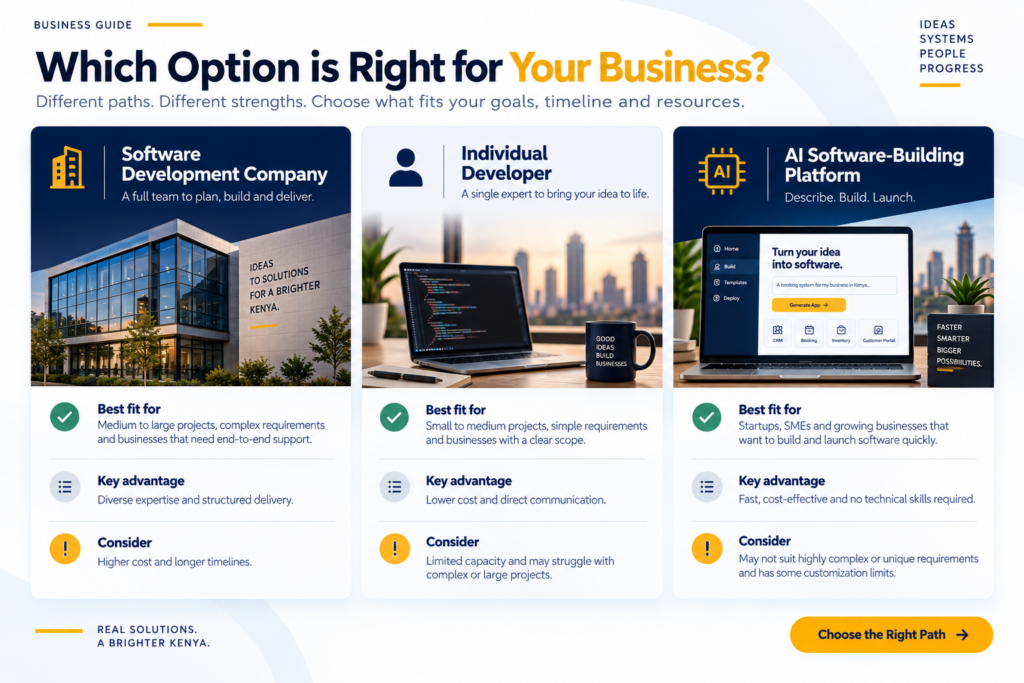
Once you understand the budget, you can decide how you want to build the software. A traditional software development company can be appropriate for complex systems, unusual requirements, regulated workflows, large integrations, or projects that need a full team from discovery through support.
An individual developer can be suitable for a smaller project when you have someone internally who can manage requirements, testing, continuity, and support. The lower initial cost can be attractive, but the business should consider availability, documentation, backup coverage, security, and what happens if the developer becomes unavailable.
Modern AI-powered software-building platforms offer another route for certain applications. They can be useful when a business wants to create a practical web application, test an idea, or build an internal workflow without following every step of a traditional development engagement.
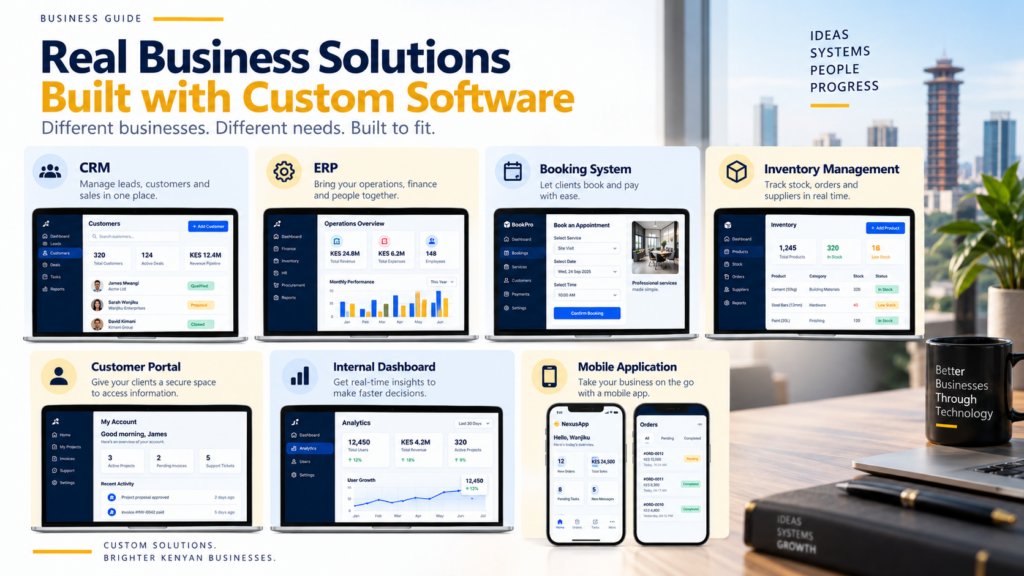
Ndovesha is positioned in this category, helping businesses create web applications around practical use cases such as customer portals, CRM systems, booking systems, inventory management systems, internal dashboards, school management systems, and SaaS platforms. You can learn more about its approach at Ndovesha.
Have a business process that software could improve?
Explore Ndovesha and create web applications around business needs, without starting from scratch.Explore Ndovesha
Frequently Asked Questions About Software Costs in Kenya
What is the cost to build a custom CRM in Kenya?
There is no universal CRM price. A basic internal CRM with contacts, notes, pipeline stages, and simple reporting may be relatively focused. Adding customer portals, automation, messaging, payments, mobile access, advanced permissions, analytics, and third-party integrations can increase the budget substantially. Ask for a scope-based estimate rather than a category-only price.
How much does ERP software cost in Kenya?
A custom ERP is usually a larger investment because it can combine finance, procurement, inventory, sales, HR, approvals, reporting, branches, and external integrations. Current Kenyan guides place substantial ERP or enterprise projects in the millions of shillings, but the range is broad because ERP scope varies enormously.
What affects web application development cost in Kenya?
The major factors include workflows, user roles, interface complexity, integrations, database requirements, authentication, reporting, mobile responsiveness, security, testing, deployment, and support. A web application can be much smaller than an ERP even though both run in a browser.
What is MVP development cost in Kenya?
An MVP can be relatively affordable when it contains only the essential workflow needed to test a business idea. Current Kenyan providers publish starting points from the low hundreds of thousands of shillings, while a more complex MVP with integrations, mobile applications, payments, or advanced workflows can cost much more.
What are software development payment models in Kenya?
Common models include fixed-price projects, time and materials, dedicated monthly teams, and support retainers. Phased delivery can be used with any of these structures. The best model depends on how stable the scope is and how much you expect the product to evolve.
How much does software maintenance cost in Kenya?
Maintenance varies according to system size, support level, infrastructure, response requirements, security work, and the number of changes included. Some providers offer monthly support packages while others price work as needed. Ask what is included and what counts as a new feature.
How to Compare Software Quotations Properly
When three providers quote different amounts, do not rank them from cheapest to most expensive and stop there. Put the proposals side by side and compare scope, workflows, number of users, platforms, integrations, design, testing, migration, deployment, training, support and ownership. Then check the assumptions behind each number. A quote can appear cheaper because a major integration is excluded, because testing is limited, because support ends at launch, or because changes are billed separately. A higher quote can be justified when it includes discovery, stronger quality assurance, better documentation, more robust security work or a larger support commitment.
Ask every shortlisted provider to answer the same questions in writing. What is included in the first release? What is explicitly excluded? What third-party costs will the business pay? What happens when requirements change? Who owns the source code and accounts? What happens after the warranty period? What are the payment milestones? How will acceptance be measured? This turns a vague price comparison into a meaningful procurement decision.
A Practical Decision Framework Before You Approve the Budget
Before approving a budget, ask yourself five questions. What problem is costing the business money or time today? What is the smallest software release that can materially improve that problem? Which requirements genuinely need to be custom? What recurring costs will exist after launch? And how will we measure whether the investment worked?
If you can answer those questions, you are in a much stronger position to speak with software companies, developers, or software-building platforms. You can compare quotations based on the same business requirements instead of comparing unexplained numbers.
Conclusion
Custom software cost in Kenya is not determined by the word “custom.” It is determined by the amount of work required to turn a business problem into a reliable system that people can use every day.
That work can include discovery, workflow design, interface design, development, integrations, data migration, security, testing, deployment, training, hosting, maintenance, and support. The more users, workflows, platforms, integrations, and operational risks involved, the more the budget can increase.
The smartest way to plan is therefore not to search for one magic price. Start with the problem, define the essential scope, separate immediate needs from future ideas, request comparable quotations, and make recurring costs visible. Use published Kenyan pricing ranges as planning guidance, but rely on a detailed scope and professional estimate for the actual decision.
And do not judge the investment only by the build price. Ask what the current problem is already costing you. If employees spend hours on manual work, customers face unnecessary friction, managers lack timely information, or disconnected systems create expensive errors, those costs belong in the business case too. This also makes later investment decisions easier because the business can see exactly which costs create value and which costs simply add complexity. The result is a budget that reflects how the software will actually be used. and gives decision makers a clearer basis for comparing providers