

Custom Software Development in Kenya: Cost, Process & AI Options
A practical guide for Kenyan businesses that want to understand software costs, local integrations, customer experience, AI application builders and the smartest way to approach a new software project.
TL;DR: Custom Software Development in Kenya
Here’s what you need to know:
- Custom software is built around your business workflows instead of forcing your business into a generic system.
- Indicative Kenyan development budgets range from hundreds of thousands of shillings for focused internal tools to several million for complex SaaS and enterprise platforms.
- M-Pesa, Airtel Money, eTIMS, payment gateways and data-protection requirements can affect both scope and cost.
- AI application builders can reduce development time, but security, testing, integrations and long-term maintenance still matter.
- The right starting point is your business problem, users, workflows and integrations—not simply the number of features you want.
What Is Custom Software Development?
Custom software is an application designed around a particular organisation’s workflow rather than a generic process shared by thousands of businesses. It might be a small internal dashboard, a CRM, a booking system, an inventory platform, a customer portal or a much larger enterprise application.
The important distinction is not size. It is fit. A good custom system reflects how your people work, what your customers need and what information the business must move from one step to the next.
Imagine a logistics company assigning drivers through spreadsheets and WhatsApp, a clinic coordinating appointments by phone, or a school reconciling fees across several files. In each case, the problem is not a lack of software in general. The problem is a workflow that does not have a reliable system around it.
That is where software development Kenya businesses increasingly consider can create value: not by adding technology for its own sake, but by removing a specific operational constraint.

Start with the workflow that needs fixing. The software comes second.
Why Kenyan Businesses Build Custom Software
The strongest reason is usually friction: duplicated data, manual approvals, slow follow-ups, disconnected systems, unclear ownership or too much work happening in spreadsheets and chat.
Kenyan businesses also operate within a technology environment that can make local integration important. A customer-facing system may need mobile-money payments. A finance workflow may need electronic invoicing. A service business may need SMS or WhatsApp communication. A system handling personal information needs appropriate privacy and access controls.
Custom software can bring these pieces into one workflow instead of asking employees to repeatedly move information between tools.
A lead arrives through a website form. Instead of landing in an inbox, the system creates a customer record, assigns the enquiry to a staff member, schedules follow-up, records the quotation and keeps the communication history attached to the customer. The business gains visibility; the customer gets a more consistent experience.
How Software Improves the Customer Journey
Software decisions are often discussed as internal efficiency projects. That misses half the picture. Customers experience the consequences of internal systems every time they submit an enquiry, make a payment, wait for an update or ask for support.
A useful way to plan a system is to map the complete customer journey first:
| Stage | Where software can help |
|---|---|
| Awareness | Landing pages, lead capture and source tracking. |
| Consideration | Customer records, quotations, automated responses and follow-up tasks. |
| Purchase / booking | Checkout, mobile-money payments, bookings and confirmations. |
| Delivery | Order status, dispatch, notifications and staff tasks. |
| Support | Tickets, customer history, escalation and service records. |
| Retention | Reminders, subscriptions, follow-ups and customer segmentation. |
| Advocacy | Reviews, referrals and post-purchase communication. |
The customer sees a smoother experience. The business sees the workflow behind it.
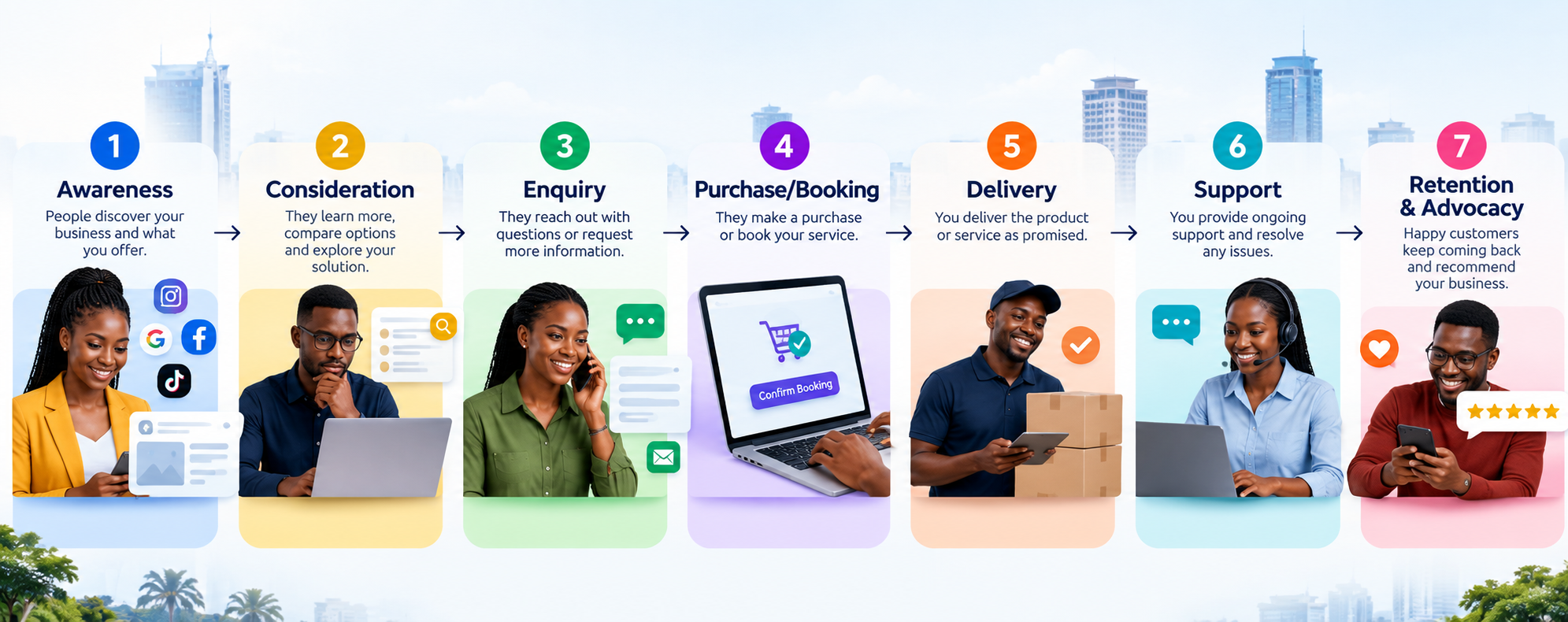
This is also why software projects should involve operations and customer-facing teams, not only the technical team. The people who use the workflow every day often know where the real bottlenecks are.
Custom Software Development Cost in Kenya
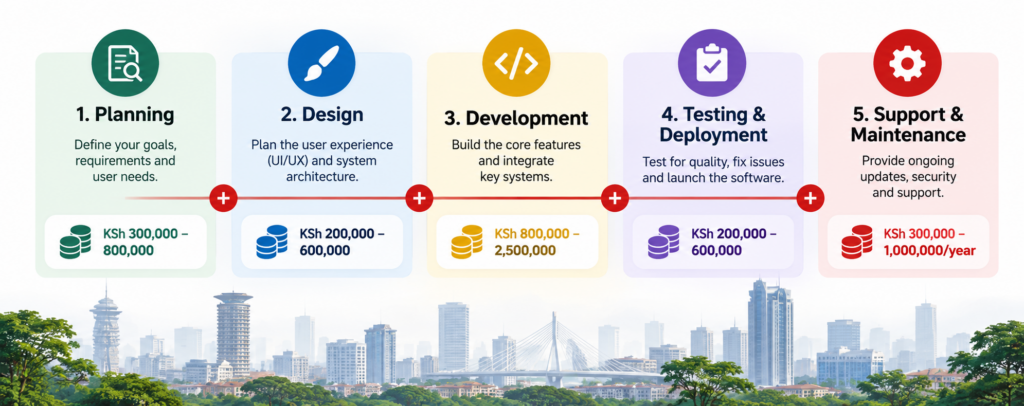
If you are searching for custom software development cost in Kenya, the most honest answer is that there is no universal price list. Two applications with the same number of screens can have completely different complexity. For a deeper breakdown of Kenyan planning ranges, see our guide to custom software costs in Kenya.
The following ranges are best treated as planning bands for 2026 rather than quotations:
| Project type | Indicative planning range | Typical scope |
|---|---|---|
| Focused internal tool / MVP | KES 300K–900K | One focused workflow, limited roles, core reporting. |
| Business application | KES 800K–2.5M | Multiple users, roles, workflows, dashboards and integrations. |
| Customer / member platform | KES 700K–3M | Customer accounts, portals, communication and transactions. |
| SaaS product | KES 1.5M–5M+ | Multi-tenant architecture, billing, onboarding and product analytics. |
| Complex enterprise platform | KES 2.5M–8M+ | Complex integrations, security, multiple departments and higher assurance. |
These figures are indicative planning ranges, not published Kenyan market tariffs. Actual project quotes depend on requirements, team composition, architecture, integrations, testing, deployment and support.
How much does it cost to build a CRM in Kenya?
A basic CRM with contacts, leads, tasks and straightforward reporting can sit toward the lower end of the business-application range. Add multiple permission levels, automated workflows, WhatsApp or SMS, payment integration, accounting, mobile access, audit trails and advanced reporting, and the project becomes materially more complex.
The lesson is simple: price the workflow, not the word “CRM.”
Want a realistic starting budget?
Get a free scope estimate based on your users, workflows and integrations instead of guessing from a feature list.
Get a Free Scope EstimateWhat Drives Software Development Cost?
Five factors usually matter more than the visual design of the application.
- Workflows: A single approval path is simpler than a system with many conditional processes.
- Users and permissions: Admin, finance, sales, operations and customer roles create different access requirements.
- Integrations: M-Pesa, Airtel Money, eTIMS, accounting, messaging and third-party APIs add technical and testing work.
- Data and security: Migration, encryption, backups, audit trails and access controls matter when the application handles sensitive information.
- Support and operations: Hosting, monitoring, maintenance, bug fixes and future changes are part of the total cost of ownership.
What about developer rates in Kenya?
Published 2026 market guides vary considerably, which is itself a useful warning against treating one salary table as a universal price list. One Kenya-focused 2025/26 guide puts software developers at roughly KES 60,000–100,000 per month for junior developers, about KES 150,000 for a typical mid-level developer, and KES 250,000–350,000 for senior or specialist developers. Other 2026 datasets show wider ranges depending on employer, seniority and market segment.
Those are employment or contract benchmarks, not what a client should automatically pay for a complete software project. A project quotation also has to cover product discovery, design, project management, QA, infrastructure, business risk and support.
Kenya-Specific Integrations and Compliance
A software project can look simple until local requirements are added. Define them early.
M-Pesa and Airtel Money
If customers need to pay inside the application, the team may need mobile-money integration rather than a manual payment-confirmation process. Safaricom Daraja APIs provide M-Pesa integration capabilities for web and mobile applications, so payment requirements should be specified during discovery rather than bolted on at the end.
KRA eTIMS
KRA describes eTIMS as its electronic Tax Invoice Management System and provides guidance for onboarding, solutions and system-to-system integration. If your workflow creates or manages electronic tax invoices, determine the appropriate integration route early. See KRA eTIMS guidance.
Data Protection Act and ODPC
Kenya’s Data Protection Act, 2019 regulates the processing of personal data and establishes obligations for data controllers and processors. The ODPC’s data protection guidance provides the regulatory framework businesses should consider when designing systems that collect or process personal information.
For software teams, that means privacy should influence architecture: what data is collected, why it is collected, who can access it, how long it is retained, how breaches are handled and which third parties receive it.
Payment gateways
Paystack’s Kenya payment information and Flutterwave’s payment-channel documentation illustrate some of the options available to businesses operating in Kenya. The correct choice depends on payment methods, settlement requirements, customer experience and the exact transaction workflow.
- Which payments must happen inside the system?
- Which invoices or records need eTIMS consideration?
- What personal data will be collected?
- Which staff can view or change it?
- Which external services need API access?
Custom Software for Small Businesses in Kenya
Custom software is not only for large enterprises. A small business can justify it when a repeated workflow consumes enough time, causes enough errors or creates enough lost revenue to make the investment worthwhile.
For a small company, the smarter approach is usually not “build everything.” It is to identify one high-value workflow and build around it. That principle is also useful when evaluating how to build business software with AI.
Instead of building a giant commerce platform, the first release could connect inventory, sales and low-stock alerts. Once staff trust the workflow, customer accounts, supplier management and deeper reporting can be added.
This staged approach reduces risk and creates evidence for the next investment.
AI Application Builder vs Low-Code vs Traditional Development
The arrival of AI changes the build conversation, but it does not eliminate the need to choose an appropriate architecture.
| Approach | Useful when | Main trade-off |
|---|---|---|
| Traditional development | Complex requirements, deep integrations, high control. | Usually slower and more resource-intensive. |
| Low-code / no-code | Standard workflows and rapid internal tools. | Platform constraints can appear as requirements become unusual. |
| AI application builder | Fast prototypes, dashboards, portals and focused business applications. | Security, ownership, maintainability and platform limits must be checked. |
| AI code assistant + developers | Teams want faster engineering while retaining architectural control. | Still requires skilled review, testing and technical ownership. |
The most useful question is not “Is AI better than developers?” It is: which combination gives this project enough speed without creating unacceptable technical or business risk?
How to Build Software With AI
If you want to build software with AI, start with the same discipline you would use for a traditional project. See our guide to AI application builders for a deeper look at this approach. The difference is that AI can reduce the time needed to move from a clear specification to a working prototype.
- Describe the business problem. State what is slow, expensive, error-prone or difficult today.
- Map the users. Identify customers, administrators, staff, managers and other roles.
- Map the workflow. Define what happens from the first action to the final outcome.
- Define the data. Decide what records the application needs and how they relate.
- List integrations. Include payments, messaging, accounting, eTIMS or other external systems.
- Build the smallest useful version. Avoid turning version one into the final product.
- Test with real users. Watch where the workflow breaks or causes confusion.
- Harden the application. Add authentication, authorisation, validation, logging, backups, monitoring and appropriate security controls.

AI Software Development: What to Watch
AI can accelerate software creation, but an AI-powered application still has to work reliably in the real world.
- Security: Generated code and configurations need review. Authentication and authorisation cannot be assumed to be correct.
- Privacy: Know what data enters the AI platform, where it is processed and what your contractual and regulatory obligations are.
- Hallucinations: AI can produce plausible but incorrect logic, assumptions or implementation details. Tests and human review are essential.
- Maintainability: A fast first version can become difficult to change if nobody owns the architecture or documentation.
- Vendor lock-in: Check whether you can export your data, code and configuration and what happens if the platform changes.
- Complexity: Highly specialised, regulated or deeply integrated systems may require experienced engineers even if AI can create an impressive prototype.
For many businesses, a hybrid model is practical: use AI to accelerate discovery, prototyping and implementation, while experienced people remain responsible for architecture, security, testing, deployment and long-term ownership.
The Custom Software Development Process
A good project is a business process with technical delivery around it. A practical sequence is:
- Discovery: document the problem, customer journey, users and current workflow.
- Scope: turn the workflow into features, data, permissions and integrations.
- Approach: compare SaaS, low-code, AI builder, traditional development and hybrid options.
- Prototype: test the important screens and workflow before committing to the full build.
- MVP: build the smallest version that can create measurable value.
- Testing: test permissions, integrations, edge cases, data and performance.
- Deployment: configure hosting, domains, backups, monitoring and access controls.
- Adoption: train users and measure whether the original problem is improving.
- Iteration: use real usage data to decide what should be added next.
The loop is simple: problem → workflow → application → user feedback → improvement.
What Kenyan Businesses Can Build
The use cases are broad, but the principle is the same: build around a real workflow. For a sector-specific example, see our guide to real estate management software in Kenya.
- Logistics: dispatch, driver management, tracking, notifications and proof of delivery.
- SACCOs: member portals, records, approvals, statements and workflow management.
- Clinics: appointments, patient workflows, billing and controlled access.
- Schools: admissions, fees, communication, attendance and administration.
- Retail: inventory, sales, purchasing, customer records and reporting.
- Real estate: property, tenant, maintenance and payment workflows.
- Agriculture: farmer records, orders, inventory, field data and supply-chain workflows.
- Hospitality: bookings, guest records, payments, operations and customer communication.
Do not build a generic “industry app” simply because the sector is large. Two clinics, schools or logistics companies can have completely different workflows.
Common Mistakes to Avoid
- Starting with features instead of the problem. A long feature list is not a product strategy.
- Comparing quotations without comparing scope. Check whether design, QA, deployment, integrations and support are included.
- Leaving integrations until the end. Payment, invoicing and external API requirements can reshape architecture.
- Building everything in version one. A smaller first release is easier to validate.
- Ignoring ownership. Clarify ownership of code, data, domains, cloud accounts and third-party accounts.
- Skipping security and privacy. These are design requirements, not finishing touches.
- Choosing a provider on a demo alone. Ask how requirements, testing, deployment, maintenance and change requests are handled.
What Makes Custom Software Successful?
Successful software is not the system with the longest feature list. It is the system that helps people accomplish an important job more reliably.
- Clear business problem: everyone understands what the software is supposed to improve.
- Simple customer journey: customers do not have to navigate internal complexity.
- Usable workflows: employees can complete tasks without excessive training.
- Appropriate technical controls: security, permissions, backups, testing and monitoring match the risk.
- Room to evolve: the business can change the system as requirements change.
If these five conditions are missing, adding more features rarely fixes the underlying problem.
Have a software idea but no technical specification?
Start with the problem, users and workflow. Ndovesha can help you explore what an AI-powered application could look like before you commit to a larger build.
Explore Ndovesha AIFrequently Asked Questions
How much does custom software development cost in Kenya?
Indicative 2026 planning bands range from about KES 300,000–900,000 for focused internal tools or MVPs to KES 2.5 million–8 million or more for complex SaaS and enterprise platforms. Business applications and customer platforms commonly sit between those extremes. The final quote depends on scope, integrations, users, security and support.
How much does it cost to build a CRM in Kenya?
A small CRM with contacts, leads, tasks and basic reporting can fit within a focused business-application budget. The cost rises with multiple roles, automation, messaging, payments, accounting, mobile access, advanced reporting and audit requirements.
Can Kenyan businesses build software with AI?
Yes. AI application builders and AI coding tools can help create prototypes, dashboards, portals and workflow applications. They still need to be evaluated for security, privacy, maintainability, ownership and integrations.
Does every business application need M-Pesa or eTIMS?
No. It depends on the workflow. If the application collects payments or handles invoicing, mobile-money or eTIMS requirements may become relevant. Define these requirements during discovery.
What should I check before hiring a software development company in Nairobi?
Check relevant experience, exact scope, integrations, security, testing, ownership of code and data, deployment, support, maintenance and how future changes are priced. Our software company selection checklist covers the procurement questions worth asking.
KEEP READING
Related Guides & Official Resources
Use these resources to move from research to a practical software decision.
Custom software cost in KenyaBudgeting ranges, cost drivers and quotation questions. How to choose a software company in KenyaA buyer’s checklist for comparing providers. Build software with an AI application builderExplore AI-assisted approaches to business software. Safaricom Daraja API documentationOfficial M-Pesa integration resources. KRA eTIMS guidanceOfficial electronic tax invoicing resources. ODPC Data Protection frameworkOfficial Kenyan data-protection guidance.Conclusion
Custom software development in Kenya is not simply a decision about who can write the code. It is a decision about how a business wants a critical workflow to operate.
For some organisations, traditional development will make sense. For others, an existing SaaS product, low-code platform or AI application builder may be enough. Increasingly, a hybrid approach can combine AI-assisted speed with human ownership of architecture, security and quality.
Start with the customer journey. Map the internal workflow. Price the actual scope. Account for local requirements such as M-Pesa, Airtel Money, eTIMS and data protection. Then choose the build approach that fits the complexity and long-term needs of the business.
The goal is not to have more software. It is to have software that makes the business easier to run and the customer experience easier to navigate.