Discover how an AI app builder can help hotels and restaurants create software around their own workflows without relying entirely on traditional development.
⏱ 18 min read
Why Hotels and Restaurants Need an AI App Builder in 2026
An AI app builder can give hotels and restaurants a practical way to create software around the workflows they actually use, without automatically committing to a large custom development project. Hospitality businesses already rely on booking systems, point-of-sale platforms, accounting tools, spreadsheets, messaging apps, and other software. The problem is often not a lack of software. It is the gap between what existing tools provide and what the business actually needs.
For an independent hotel, restaurant, growing hospitality group, or operations team, that gap can show up everywhere: housekeeping updates, staff tasks, maintenance requests, supplier approvals, guest requests, inventory visibility, reporting, loyalty programs, and internal communication. An AI app builder for business creates another option: build the missing workflow instead of forcing the business to redesign itself around software that was built for everyone.
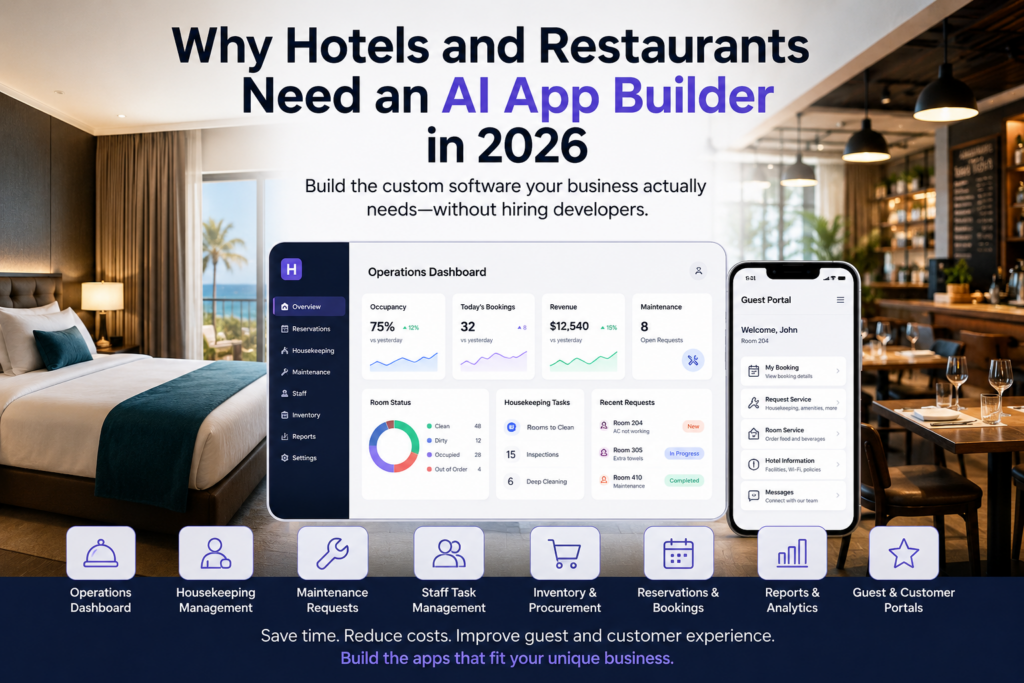
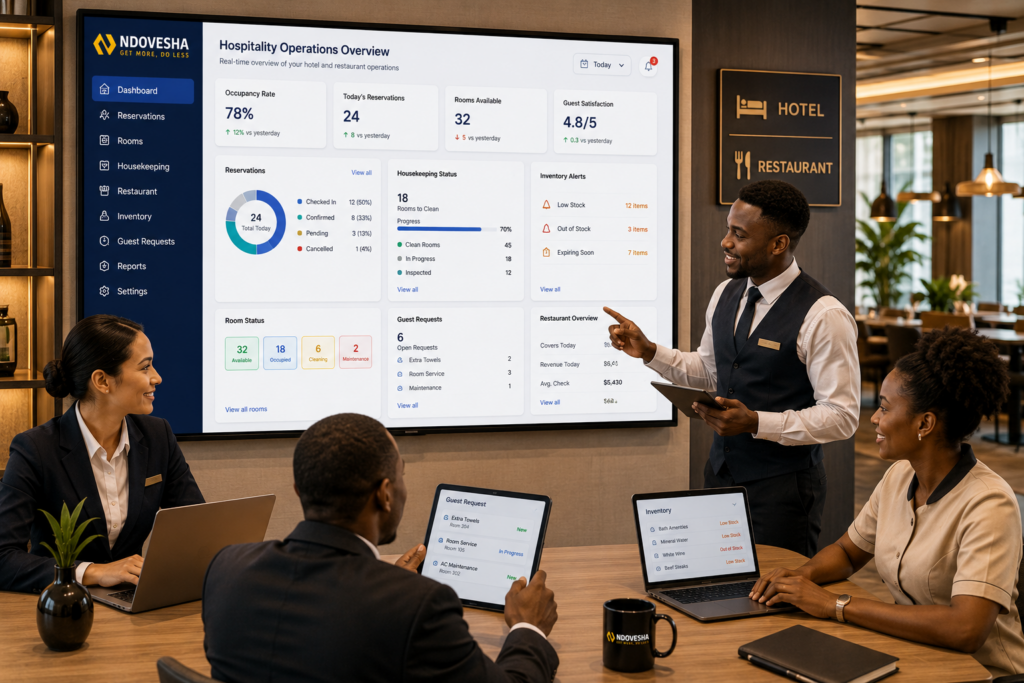
AI-powered hospitality software helps hotel and restaurant teams manage reservations, rooms, housekeeping, inventory, and guest requests from one dashboard.
Key takeaway: Hotels and restaurants may already have plenty of software, but they often still have important workflow gaps. An AI app builder can help them create custom applications for those gaps faster and with less traditional development overhead.
Hospitality businesses often use multiple disconnected systems for reservations, POS, accounting, inventory, staffing, and communication.
Custom software has traditionally required developers, agencies, larger budgets, and longer implementation timelines.
An AI software builder can help teams prototype and build applications around specific operational problems.
Potential use cases include housekeeping, maintenance, staff tasks, inventory, guest portals, supplier workflows, loyalty, reporting, and operations dashboards.
The strongest approach is often not replacing every existing hospitality platform, but building the software that fills the gaps around those systems.
Hotels and Restaurants Already Use Software — So What’s Missing?
Hospitality businesses are not new to technology. A hotel might have a property management system, online booking channels, payment tools, accounting software, housekeeping tools, email, and messaging applications. A restaurant may have a point-of-sale system, delivery integrations, accounting software, reservation tools, inventory records, and staff communication channels.
Yet having software does not necessarily mean having the right software.
The problem appears when a business develops a workflow that does not fit neatly inside its existing platforms. A general-purpose system might manage reservations very well but provide little help with a hotel’s internal maintenance process. A restaurant POS may be excellent at processing orders and payments but offer limited support for the restaurant’s supplier approval workflow, staff checklists, catering operations, or custom management reports.
That creates what we can think of as a software gap: the distance between the capabilities a business already has and the capabilities it actually needs.
For many hospitality businesses, that gap has traditionally been handled with spreadsheets, paper forms, phone calls, email threads, and WhatsApp messages. It works — until the business becomes busy enough that the manual workaround itself becomes a problem.
The Problem With One-Size-Fits-All Hospitality Software
Hospitality software is often designed to solve standardized problems at scale. That is useful because businesses do not want to reinvent basic functions such as reservations, payments, accounting, or point-of-sale operations.
The challenge is that every hotel and restaurant also has processes that are specific to its property, team, service model, brand, or management structure. Those processes are where generic software can become restrictive.
Consider a hotel with a specific internal rule for preparing rooms before VIP arrivals. The workflow may involve housekeeping, front desk, maintenance, food and beverage, and management. If the existing systems do not support that exact process, the team may create a spreadsheet or WhatsApp group to coordinate it.
Now consider a restaurant that operates dine-in service, delivery, private events, and outside catering. The POS can capture sales, but the business may still need a custom workflow for catering quotations, approvals, supplier coordination, event preparation, and post-event reporting.
This is where an AI application builder becomes interesting. Instead of asking whether one existing platform can do everything, the business can ask a different question:
What software capability is missing, and can we build that capability around our existing systems?
Why Custom Software Has Traditionally Been Out of Reach
For years, the obvious answer to a unique software requirement was custom development. A business would document its requirements, speak to an agency or development team, agree on a scope, fund the project, test the application, and then continue paying for maintenance and future changes.
That model can make sense for large technology initiatives. It can be much harder for a single hotel, independent restaurant, or growing hospitality business that needs a focused internal application rather than a massive software platform.
The challenge is not only the developer cost. There is also the cost of project management, requirements gathering, design, testing, hosting, integrations, maintenance, and changes when the business process evolves.
For a smaller business, this creates a frustrating choice: keep living with a manual workflow, buy a generic tool that only partly fits, or make a significant investment in software development.
An AI app builder introduces a fourth option. It allows a team to describe the application it needs, generate a starting point, review the result, and iterate without making the entire process dependent on traditional development from day one.
That does not mean every hotel or restaurant should eliminate developers. Complex systems, sensitive workloads, advanced integrations, and high-risk environments may still require technical professionals. The opportunity is to reduce the amount of custom development needed for the many smaller applications and workflows that sit around core hospitality systems.
A hotel does not necessarily need to build a replacement for its property management system. In many cases, the more valuable opportunity is to build an application around a specific process that existing software does not handle well.
A hotel could build an internal dashboard that brings together the operational information managers need to see in one place. The dashboard could organize room status, tasks, maintenance issues, guest requests, follow-ups, and operational metrics according to the hotel’s own workflow.
Housekeeping Management System
A custom housekeeping application could allow staff to view rooms requiring attention, update cleaning status, record issues, assign tasks, and notify supervisors when rooms are ready. Instead of relying on separate messages or manual lists, the hotel gets a workflow designed around how its housekeeping team actually works.
Maintenance Request System
A maintenance application could let staff submit issues from a phone or workstation. A request might include a room number, issue category, description, urgency, assigned technician, status, and completion note.
A simple workflow could move an issue from Open → Assigned → In Progress → Completed. Managers could then see unresolved issues without searching through conversations.
Guest Service Portal
A hotel could create a customer-facing portal where guests view information, make service requests, access property details, or communicate specific needs. The exact experience can be shaped around the property’s service model rather than a generic template.
Staff Task Management System
Managers could build an internal application for opening tasks, closing tasks, shift handovers, inspections, event preparation, room checks, and recurring operational responsibilities.
Supplier and Procurement Workflow
A custom supplier workflow could support purchase requests, approvals, quotations, delivery tracking, and documentation. The aim is not necessarily to replace accounting software, but to give the procurement team a workflow for the steps that happen before and around financial recording.
Custom Management Reporting
A hotel can define the metrics that matter to its management team rather than relying exclusively on a standard report. An internal application can organize operational information around the decisions managers actually make.
What Could a Restaurant Build With an AI App Builder?
Restaurants have the same underlying opportunity: keep specialized systems for specialized jobs, then build lightweight applications around the workflows that remain manual or fragmented.
Restaurant Operations Dashboard
A restaurant could build a management dashboard for daily sales, reservations, staffing, inventory alerts, supplier activity, catering jobs, operational tasks, and performance indicators.
Kitchen Order and Workflow Management
Where the existing POS does not fully support a particular kitchen workflow, a restaurant could create a supporting application for preparation tasks, special orders, large-event coordination, or other operational steps.
Staff Scheduling and Task Management
A restaurant could create a system for shift schedules, opening procedures, closing checklists, role-specific tasks, manager approvals, and handovers.
Supplier Management System
Supplier requests and follow-ups can be managed in a dedicated workflow. Staff can create a request, managers can approve it, suppliers can be tracked, and the business can monitor outstanding deliveries or issues.
Inventory Management System
A restaurant can build an inventory application around its own categories, stock rules, approval process, and reporting needs. This can be particularly useful when the business has inventory processes that do not fit cleanly into the standard tools already in use.
Customer Loyalty Portal
A custom customer portal could organize loyalty activity, offers, preferences, event invitations, or membership information around the restaurant’s own customer strategy.
Reservations and Private Events
A restaurant that handles private dining, corporate events, weddings, or catering may need a workflow that is more detailed than a standard reservation system. An application can support enquiries, quotations, approvals, menus, deposits, suppliers, preparation tasks, and event completion.
Food Cost and Management Reporting
Management can build an internal application around the specific operational metrics it wants to monitor instead of manually combining data from several sources.
Key insight: The goal is not necessarily to replace the restaurant’s POS. The smarter opportunity may be to build the software that sits around the POS and solves the problems the POS was never designed to solve.
The Hidden Cost of Running Hospitality Businesses With Spreadsheets and WhatsApp
Spreadsheets and messaging apps are useful. They are also incredibly easy to adopt, which explains why they become part of business operations in the first place.
The problem starts when a workaround becomes a critical system.
A maintenance request buried in a WhatsApp conversation can be forgotten. A staff schedule in a spreadsheet can become outdated. An inventory file can have multiple versions. A manager can spend part of every morning combining information from different sources just to understand what happened yesterday.
These costs are rarely visible as a software subscription. They appear as administrative time, duplicated work, missed follow-ups, poor visibility, inconsistent handovers, and slower decisions.
For a hospitality business, operational speed matters. A delayed room update can affect check-in. A missing stock item can affect service. A forgotten maintenance request can affect a guest experience. A delayed supplier approval can affect an event.
The better question is not always “How much does software cost?” It can also be: “How much is the business already paying for not having the right software?”
An AI business app builder is valuable when it helps convert these recurring manual workarounds into clear, repeatable workflows.
AI App Builder vs Buying Hospitality Software
This does not have to be an either-or decision. A hotel or restaurant can keep the software that already works well and use an AI app builder to handle the gaps.
Requirement
Generic Hospitality Software
AI App Builder
Standard booking
Strong fit
Can support custom booking workflows
Standard POS
Strong fit
Better suited to supporting workflows around it
Custom internal workflow
May be limited
Can be designed around the business process
Custom dashboard
Depends on platform
Can be tailored to specific management needs
Unique staff workflow
May require workarounds
Can be built around the workflow
Customer portal
Depends on platform
Can support a custom experience
Rapid prototype
Limited
Strong fit
The right strategy is often complementary: use specialized hospitality software for standardized functions, and use an AI software builder for the custom workflows the business needs around those systems.
How a Hotel or Restaurant Can Build an Application With AI
The best AI application development process starts with the business problem, not the software.
Identify the bottleneck: Choose one workflow that is repetitive, fragmented, slow, or difficult to manage.
Map the current process: Write down who does what, when each step happens, what information is required, and where the process currently breaks.
Define users and permissions: Decide which staff members, managers, suppliers, or customers need access and what each person should be able to do.
Describe the application: Turn the workflow into a clear application brief with screens, fields, actions, statuses, notifications, and reports.
Generate the first version: Use an AI app maker to create an initial application from the requirements.
Test with real scenarios: Ask the people who actually use the process to test it using realistic cases.
Refine and deploy: Fix gaps, improve the workflow, connect relevant services, and deploy when the application meets the required standard.
This approach is particularly useful for non-technical founders and operations managers because they can start with the workflow they understand best: the business process itself.
Examples of AI Applications a Hospitality Business Could Build
The possibilities become easier to understand when they are mapped directly to business users and operational problems.
Application
Who Uses It
Problem It Can Address
Housekeeping System
Housekeeping team
Room status and task coordination
Maintenance Portal
Staff and maintenance team
Issue reporting and follow-up
Supplier Portal
Procurement team and suppliers
Requests, approvals, and delivery tracking
Guest Portal
Hotel guests
Service requests and guest information
Staff Dashboard
Managers and employees
Tasks, schedules, checklists, and handovers
Inventory System
Stores and management
Stock visibility and replenishment workflows
Booking Dashboard
Management
Operational visibility around reservations
Loyalty Portal
Customers and marketing teams
Customer engagement and membership workflows
Catering System
Restaurant events team
Event enquiries, approvals, preparation, and follow-up
Operations Dashboard
Owners and managers
Custom management visibility
Why AI App Builders Could Be Particularly Valuable to Independent Hotels and Restaurants
Large hotel groups and restaurant chains can justify dedicated technology teams, enterprise software, consultants, integrations, and long implementation projects. Smaller operators often cannot.
That creates an interesting technology gap. Smaller businesses can have highly sophisticated operational requirements, but they may not have the technical resources to build custom software for every requirement.
This is where an AI app builder can potentially expand what a smaller team can do. Instead of needing to hire an entire software department for every application, a business can start with a narrow use case, build a working version, test it, and decide whether it deserves further investment.
For a non-technical founder, the value is not simply “AI writes code.” The larger value is that the founder can describe the operational problem in business language and participate directly in shaping the application.
That same principle extends beyond applications. Ndovesha’s broader AI Workers positioning is built around deploying specialized AI capabilities for different business functions rather than treating AI as a single generic tool.
AI App Builder for Hotels and Restaurants: Is It Worth It?
An AI app builder is worth exploring when a hospitality business has a software gap that keeps creating manual work, delays, errors, or unnecessary operational complexity.
It may be a strong candidate when a hotel or restaurant:
Relies heavily on spreadsheets for important operational workflows.
Uses WhatsApp or email to coordinate processes that should have a clear workflow.
Has repetitive administrative tasks that could be turned into structured processes.
Uses several disconnected systems and needs an internal layer around them.
Needs a custom dashboard for management.
Needs a staff, supplier, or customer portal.
Wants to test a software idea before committing to a major development project.
Needs custom software but cannot justify a traditional development budget yet.
The best starting point is usually not the biggest application imaginable. Pick one problem that happens often, matters to the business, and can be measured. Build around that problem first.
Frequently Asked Questions
Can a hotel build its own software with AI?
Yes. An AI app builder can help a hotel create applications around specific workflows such as housekeeping, maintenance requests, staff tasks, guest services, procurement, reporting, or internal operations. The suitability of a platform depends on the application’s complexity, integrations, security requirements, and deployment needs.
Can a restaurant build a management system with AI?
A restaurant can use an AI software builder to prototype and build management applications for areas such as inventory, staff tasks, supplier workflows, private events, catering, customer loyalty, and custom reporting. In many cases, the application can complement rather than replace the restaurant’s existing POS.
Can AI build a hotel booking system?
AI can help generate the components of a booking application, but a production booking system should be evaluated carefully for data handling, payments, availability logic, security, integrations, and operational reliability. Businesses should choose the appropriate architecture for the risk and complexity of the system.
Can AI build a restaurant ordering system?
AI can help create ordering workflows and interfaces, but businesses should evaluate payments, order routing, menu management, availability, authentication, reporting, and integrations before deploying such a system in production.
Can an AI app builder integrate with existing hotel software?
Integration depends on the platforms involved and the capabilities of the AI app platform. APIs, webhooks, exports, databases, and third-party connectors can provide different ways to connect systems. Always confirm the available integration methods before selecting a platform.
Do hotels need custom software?
Not every hotel needs custom software. The stronger case exists when important workflows are repeatedly handled through spreadsheets, messaging apps, paper, or manual coordination because existing software does not fit the process.
How much does custom hotel software cost?
The cost varies significantly with scope, integrations, security, design, user roles, hosting, and ongoing maintenance. An AI app builder can change the economics of smaller applications, but businesses should still assess the full cost of building, operating, securing, and supporting the software.
Can a non-technical person build an application with AI?
Many AI app builders are designed to lower the technical barrier by allowing users to describe requirements in natural language and work with templates or visual interfaces. Non-technical users can still benefit from having someone review architecture, security, integrations, and production requirements for more complex applications.
What is the best AI app builder for a hotel or restaurant?
The best platform depends on the workflow being built, the integrations required, the level of customization, deployment requirements, team collaboration, and budget. A useful comparison should focus on whether the platform can solve the specific software gap your business has.
Explore Ndovesha
If you are evaluating an AI app builder for a hotel, restaurant, or hospitality group, these Ndovesha resources can help you move from research to implementation:
AI App Builder — Build web applications and business systems with an Application Worker.
AI Website Builder — Create and publish business websites with the Website Worker.
AI Landing Page Builder — Create focused landing pages for hospitality campaigns and offers.
AI Blog Writer — Create supporting content and marketing copy alongside your software workflow.
AI Workers — Deploy specialized AI capabilities for different business tasks.
AI Automation — Explore AI-powered execution for repetitive business and marketing work.
Features — Compare platform features and AI Workers.
Documentation — Browse Ndovesha product guidance and FAQs.
Conclusion
Hotels and restaurants do not necessarily need more software. They need the right software for the gaps in their operations.
An AI app builder gives hospitality businesses another way to approach that problem. Instead of immediately commissioning a large custom software project or accepting a manual workaround, a hotel or restaurant can identify one important workflow, describe what it needs, build a first version, test it with the people who use it, and improve it over time.
That is particularly relevant for independent and growing hospitality businesses that may not have the budget for a dedicated software team but still need better operational capability.
The opportunity is not to replace every booking platform, POS, accounting system, or hospitality application. It is to build the software that fills the gaps those systems leave behind.
Start with the gap, not the technology. Find the process your hotel or restaurant is repeatedly managing with spreadsheets, messages, paper, or manual coordination. That may be the best candidate for your first AI-built application.