
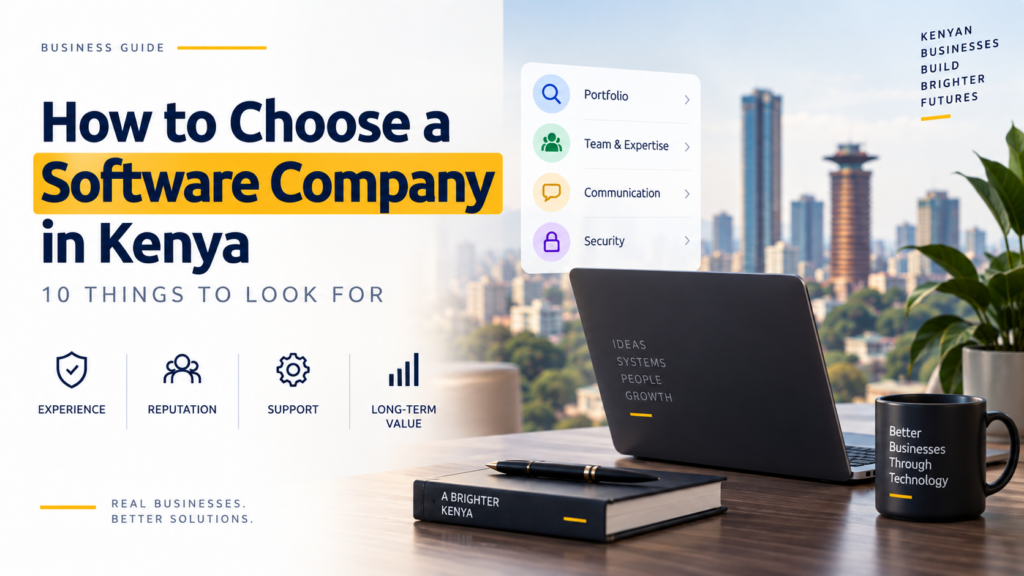
Choosing the right software partner can save your business time, money, and frustration. Here are 10 practical things to look for when comparing software companies in Kenya.
⏱ 18 min read
Choosing a software company can feel like a difficult decision, especially when you know what your business needs to achieve but do not know much about how software is built. You may know that your team is spending too much time on automation gaps, customers are struggling to access your services, information is scattered across spreadsheets, or your current systems are simply no longer keeping up with the business.
At that point, the natural question is: who can build software for my business? You may start searching for software companies in Kenya, asking friends for recommendations, comparing prices, or looking at companies that advertise themselves as the best software companies in Kenya.
But finding a company is only the first step. The bigger question is how to choose the right one.

Key takeaway: Choosing a software company is a business decision, not just a technology decision. Look beyond the quotation and evaluate whether the provider understands your problem, has relevant experience, communicates clearly, offers transparent pricing, provides support, protects your information, and can grow with your business.
- Start with the business problem before choosing the software.
- Compare experience, previous work, communication, pricing, timelines, support, security, and reputation.
- Think about both the buyer journey and the customer journey.
- Choose software based on the experience you want your customers and staff to have.
- Think beyond launch: good software should improve as your business learns and grows.
- Understanding the Buyer Journey Before You Choose
- 1. Make Sure They Understand What You Need
- 2. Look for Relevant Experience
- 3. Check Their Past Work
- 4. Pay Attention to Communication
- 5. Understand the Pricing Clearly
- 6. Ask About the Project Timeline
- 7. Check What Support You Get After Launch
- 8. Ask How They Protect Your Business Data
- 9. Check Reviews and Reputation
- 10. Think About Long-Term Fit
- How Software Shapes the Customer Journey
- Questions to Ask a Software Company
- How Much Does Software Development Cost in Kenya?
- Choosing the Right Way to Build Your Software
- Further Reading
- Frequently Asked Questions
- Conclusion
Understanding the Buyer Journey Before You Choose
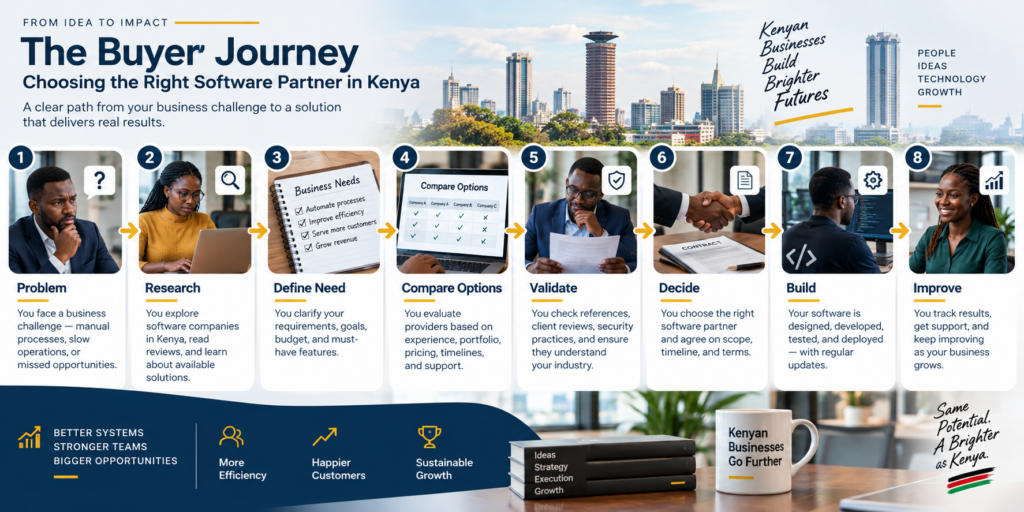
A useful way to approach the decision is to think about the entire buyer journey, rather than jumping straight from “we need software” to “which company should we hire?”
The journey can be described in eight stages:
Problem → Research → Define Need → Compare Options → Validate → Decide → Build → Improve
Problem
Every good software project starts with a business problem.
Do not start by saying, “We need an app.” Start by saying, “We need to solve this problem.”
Research
Still comparing the market? Our main guide, Software Companies in Kenya: A Complete Guide to Choosing the Right Software Partner, covers the broader landscape. This article goes one step further: once you have a shortlist, use the framework below to evaluate which provider is actually right for your business.
Look at websites, portfolios, reviews, case studies, social media pages, and recommendations. At this stage, you are not necessarily choosing a company yet. You are learning what is possible and what different providers offer.
Define Need
Research should help you turn a general problem into a clearer requirement. If you are still exploring what is possible, Ndovesha’s guide on building the software your business needs with AI is a useful next step because it explains how a business problem can become a practical application.
Instead of saying, “We need software to manage customers,” you might define the need as: “We need a simple system where our sales team can record customers, follow up with leads, see previous conversations, and know which deals are likely to close.”
The clearer the problem, the easier it becomes for a software company to recommend the right solution. If you are asking how to choose a software developer in Kenya, begin with that clarity rather than a list of technical features.
Compare Options
Now compare providers. Look at experience, previous work, pricing, communication, timelines, support, and how well each company understands your requirements.
Do not compare quotations without comparing what those quotations contain. A lower price may simply mean that fewer services are included. Learning how to compare software companies means comparing scope, quality, communication, risk, and support alongside the figure on the page.
Validate
Before committing, validate your choice. Speak to previous customers where possible. Ask to see examples of similar work. Check reviews. Ask difficult questions. Make sure the company understands what you want to build.
Decide
Once you have enough information, choose the provider that gives you the strongest overall combination of value, experience, trust, communication, and suitability.
Build
This is the stage where the idea becomes a working product. Stay involved. Test early versions. Give feedback. Make sure the software is solving the original problem instead of becoming a collection of unnecessary features.
Improve
Software should not be treated as something that is built once and forgotten. After launch, your customers and employees will show you what works and what needs to change. The best systems improve as the business learns.
Key insight: A good software buying decision starts before you contact a software company and continues after the software is launched.
1. Make Sure They Understand What You Need
The first thing to look for in a software company is surprisingly simple: do they understand your business?
A provider should be interested in the problem behind the project. If you say that you need a booking system, for example, they should ask how customers currently book, who confirms bookings, how cancellations are handled, whether payments are involved, what information staff need to see, and what happens when a booking changes.
This matters because the same type of software can work very differently from one business to another.
If you are thinking about choosing a software company, pay close attention during your first conversation. Are they listening? Are they asking useful questions? Are they trying to understand your customers? Are they interested in your goals?
A company that immediately starts selling features without understanding the problem may not be the best fit.
What to look for: Choose a team that talks about your business, customers, staff, goals, and challenges — not just technical features.
2. Look for Relevant Experience
Experience matters because software projects involve many decisions. A company that has already worked on similar problems is more likely to understand the practical issues that can appear along the way.
When comparing a software development company Kenya business might hire, ask whether they have built something similar to what you need.
For example, if you run a school, you may want business software Kenya organisations can use for admissions, student records, fee tracking, communication, and reporting. If your shortlist is based in the capital, software development Nairobi providers may offer convenient access, but location should never outweigh relevant experience, communication, security, and support.
Relevant experience does not mean the company must have worked with an identical business. What matters is whether they understand similar business processes and can demonstrate that they have solved comparable problems.
This is particularly important for small businesses that need practical software without unnecessary complexity.
Ask questions such as:
- Have you built something similar?
- What did you learn from that project?
- What challenges came up?
- Can I see an example?
- What would you recommend doing differently for my project?
3. Check Their Past Work
A portfolio can tell you much more than a list of services. A strong software company portfolio should help you judge the quality of the work, not merely prove that the provider has been busy.
Before selecting among the best software companies in Kenya, look at the actual work they have delivered. Does the software appear easy to use? Does it look designed around real business needs? Can you understand what the product does?
Ask whether the company can demonstrate live examples or walk you through previous projects. Pay attention to both appearance and usefulness.
Good software is not simply about making something look modern. It should help people complete tasks without unnecessary confusion. For businesses that are also considering their wider digital presence, Ndovesha’s guide on how to build a website with AI shows how the same outcome-focused thinking can be applied to a business website.
If a company claims to provide software development services Kenya businesses need, its previous work should give you some confidence that it can deliver on that promise.
4. Pay Attention to Communication
Communication can make or break a software project.
Even an excellent technical team can create a frustrating experience if clients do not know what is happening. You should understand what is being built, what has been completed, what is still outstanding, what decisions you need to make, and whether anything is affecting the timeline.
This is especially important if you are not technical. A trustworthy software company in Kenya should be comfortable explaining complicated matters in simple business language.
Before signing a contract, observe how the company communicates. This is part of how to evaluate a software company: the sales conversation is an early preview of the working relationship.
Do they reply within a reasonable time? Do they answer your actual questions? Do they document important decisions? Do they tell you when something is likely to take longer than expected?
You are not just hiring people to write software. You are entering a working relationship.
If communication is already difficult during the sales process, imagine how difficult it could become when the project is more complicated.
5. Understand the Pricing Clearly
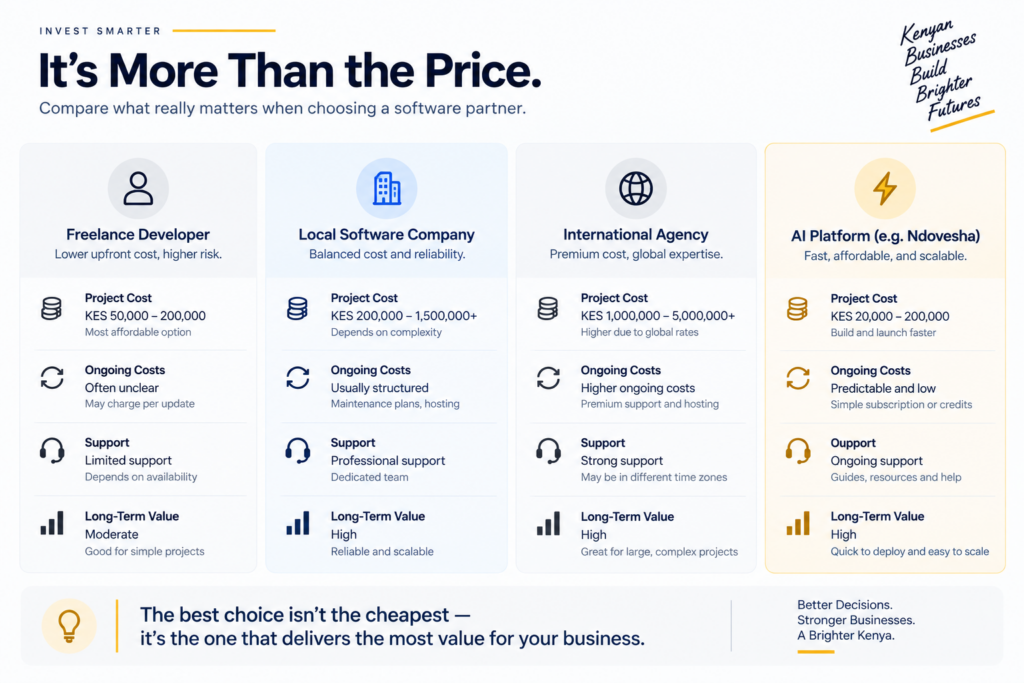
Price is one of the most important factors when choosing a provider, but it should not be the only factor.
When comparing software providers, ask what you are actually getting for the money. Two companies can give you different prices for what appears to be the same project because their scope, support, design work, testing, hosting, training, and maintenance arrangements may be different.
Ask for the quotation to be broken down clearly. You should understand the main work involved and what could result in an additional charge. A provider should also explain its software company pricing in terms you can use to plan a realistic budget.
| Pricing Question | Why It Matters |
|---|---|
| What is included? | Helps you understand what you are actually paying for. |
| Are there ongoing costs? | Shows the longer-term cost of running the software. |
| Are changes charged separately? | Helps you plan for new requirements. |
| Is support included? | Clarifies what happens after launch. |
| What happens if the project grows? | Helps you understand future costs and options. |
When researching software development cost Kenya, remember that there is no universal price. A simple business tool and a large customer-facing platform are very different projects.
The better question is not simply, “Who is cheapest?” It is, “Which provider gives us the right solution for the value we need?”
6. Ask About the Project Timeline
Before starting, ask how long the project is expected to take and what the major stages will be. A clear software project timeline should show major milestones, review points, testing, launch, and the responsibilities of both sides.
If you are asking, “How long does it take to build software?”, there is no single answer. A simple application can be much quicker to build than a large system with many users, payments, reports, integrations, and different types of access.
However, a professional provider should still be able to explain the expected process. Ask when you will see the first version, when you can test it, and what factors could affect the schedule.
Avoid promises that sound too good to be true. At the same time, avoid projects that have no clear milestones or expected delivery points.
A useful timeline should help you understand what happens first, what happens next, and when you will be involved. for your team and customers daily
7. Check What Support You Get After Launch
The day your software goes live is not necessarily the end of the relationship.
Your team may discover questions after using the system. A customer may report a problem. You may want a new feature. Your business may change and require the software to change with it.
This is why support should be part of the buying decision.
When comparing providers, ask what happens after launch. Is there a support period? Who do you contact? How quickly are problems addressed? Are updates included? How are larger changes handled?
Clear answers give you confidence that you will not be left alone after paying for the project.
Key insight: The value of software is measured over time. A system that works well today but cannot be supported or improved may become a problem later.
8. Ask How They Protect Your Business Data
Software often handles valuable business information. This could include customer details, employee records, documents, transactions, business reports, or other private information. For a broader framework around managing AI-related risks, the NIST AI Risk Management Framework provides useful guidance on responsible risk management.
For Kenyan businesses, the conversation should also reflect the way the business actually operates. Ask about the systems your team already relies on, payment workflows, mobile access, customer communication, and any local compliance requirements that apply to your industry. The right provider should be able to explain how the proposed software will fit into that environment rather than forcing your business into a generic process.
You do not need to understand every technical security measure to ask sensible questions. Ask who can access your data, how accounts are protected, how backups are handled, and what happens if there is a problem.
If your business depends on custom software, security should be discussed from the beginning rather than treated as an afterthought.
A provider should be able to explain its approach in language you understand. If you ask a basic security question and receive an unclear answer, ask for clarification before moving forward.
9. Check Reviews and Reputation
Reviews can give you an idea of what it is actually like to work with a company.
Search for software company reviews in Kenya, read testimonials, check business profiles, look at case studies, and pay attention to comments from previous customers.
If you are trying to find a provider you can trust, reputation is useful evidence, but it should be considered alongside the company’s portfolio and your own conversations with the team.
It can also be useful to ask whether you can speak to a previous customer who had a similar project, where appropriate.
10. Think About Long-Term Fit
Your business is unlikely to remain exactly the same after your software is launched.
You may gain more customers, add employees, open another branch, introduce a new service, or discover that customers want a feature you did not originally consider.
That is why you should think about whether the provider can support your business over time. This matters whether you are buying custom software for businesses or a smaller internal application.
A good software partner should be able to discuss what happens when your needs change. The right software development support should cover more than emergency fixes; it should give you a sensible path for maintenance and future improvements. You may start with a simple booking system and later add customer accounts, payments, notifications, reporting, or other capabilities.
The strongest software solutions Kenya businesses can adopt are not necessarily the biggest systems. They are systems that fit the business today while leaving room for sensible growth tomorrow.
How Software Shapes the Customer Journey
Choosing software should not only be about what happens inside your company. It should also be about what happens to the people who buy from you.
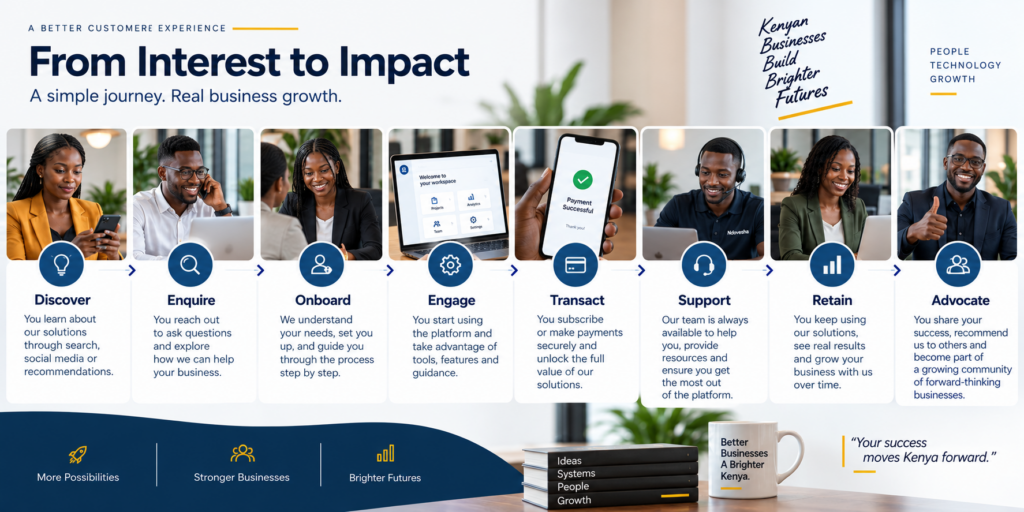
Consider the customer journey:
Discover → Enquire → Onboard → Engage → Transact → Support → Retain → Advocate
Discover
This is when a potential customer first comes across your business. They may find you through search, social media, a referral, advertising, or your website.
Enquire
A customer sends a message, fills out a form, calls, requests a quotation, or asks a question.
Onboard
Once the customer decides to work with you, onboarding begins.
Instead of asking customers to repeatedly send documents or information through different channels, a customer portal or online process can make onboarding more organized and easier to follow.
Engage
Software can help your business keep records of previous interactions, send reminders, provide updates, and give customers access to information without requiring them to contact staff every time.
Transact
This is where the customer buys, pays, books, renews, or otherwise completes a transaction.
A smoother transaction process can reduce unnecessary delays and make it easier for both the customer and the business to keep accurate records.
Support
Customers will eventually have questions or problems. Software can help your support team see customer information quickly, track requests, and make sure issues do not disappear between different employees.
Retain
A good customer experience gives people a reason to return.
Customer records, reminders, follow-ups, loyalty programs, subscriptions, and personalized communication can all help a business maintain relationships over time.
Advocate
Software cannot manufacture loyalty on its own, but it can remove friction from the experiences that help customers trust your business.
Key insight: The right software does more than automate internal work. It can improve the journey your customers experience from their first enquiry to becoming a repeat customer or advocate.
Questions to Ask a Software Company Before You Hire Them
If you are still wondering what to look for in a software company, the questions you ask can reveal a lot about the provider.
- Have you built something similar before?
- Can I see examples of your previous work?
- How will you understand how my business currently works?
- What would you recommend based on my business problem?
- How long will the project take?
- What exactly is included in the price?
- Are there monthly or ongoing costs?
- What happens if I want to add features later?
- Who owns the software and business data?
- How will customer and business information be protected?
- What support is provided after launch?
- How will I know what stage the project is at?
- How will my staff be introduced to the new system?
These are practical questions to ask a software company, and you do not need technical knowledge to ask them. A good provider should welcome these questions rather than make you feel uncomfortable for asking them.
How Much Does Software Development Cost in Kenya?
One of the most common questions businesses ask when they begin researching software is, “How much does it cost to build software in Kenya?”
The honest answer is that it depends on what you are building.
A simple internal tool may require a very different budget from a large customer-facing application. The number of users, number of features, design requirements, integrations, payment functionality, reporting, security requirements, and ongoing support can all affect the final cost.
That is why a useful quotation should be based on your actual requirements rather than a generic price.
When comparing companies that build software in Kenya, ask each provider to explain what its price covers. This is particularly important when considering custom software development Kenya businesses may rely on for processes that off-the-shelf tools cannot handle. One company may include design, testing, deployment, training, hosting, and support while another may charge for these separately.
The goal should be to find a solution where the expected business value makes sense for the investment. If your starting point is a website rather than a full business application, you can also compare the considerations in Ndovesha’s website cost in Kenya guide when planning the wider digital budget.
Choosing the Right Way to Build Your Software
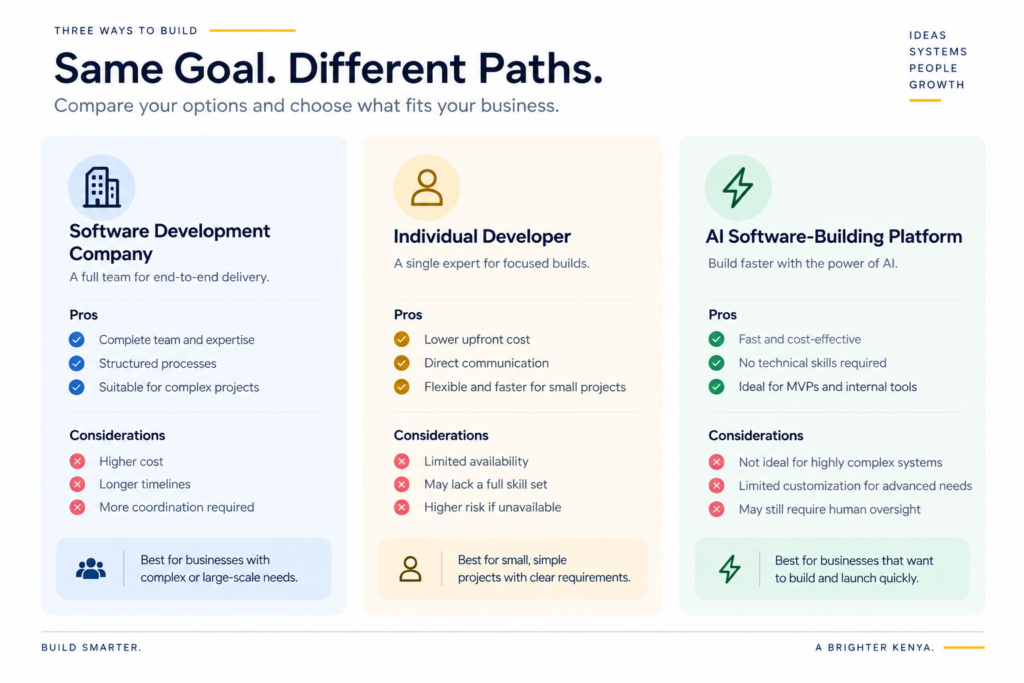
Once you understand the problem, you have several possible ways to get software built. The right approach depends on the size of the project, your budget, how quickly you need the solution, and how much customization you require.
Hire a Software Development Company
This can be a strong option when you need a highly customized system or want a team to manage the project from planning through launch and support.
Work With Individual Developers
Working with individual software developers in Kenya can make sense for smaller projects or businesses that already have someone internally who can manage the work.
Use a Modern Software-Building Platform
For certain business applications, modern software-building platforms can provide another option. These platforms can help businesses create useful applications without following every step of a traditional development process.
This can be attractive when the goal is to solve a clearly defined business problem quickly, test an idea, or start with a practical application before committing to a larger development project.
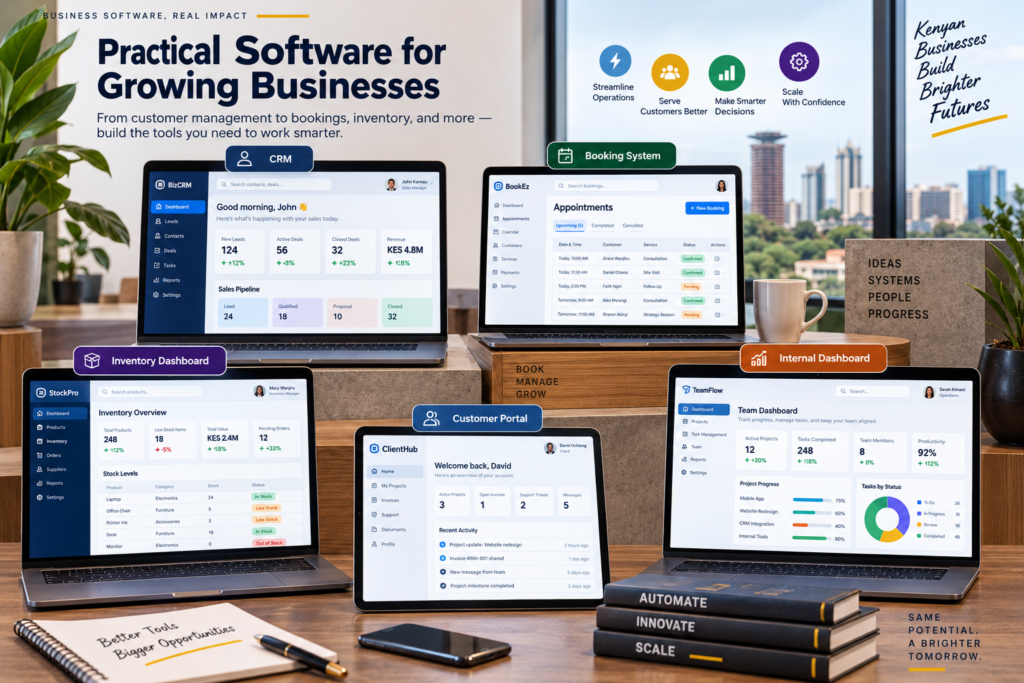
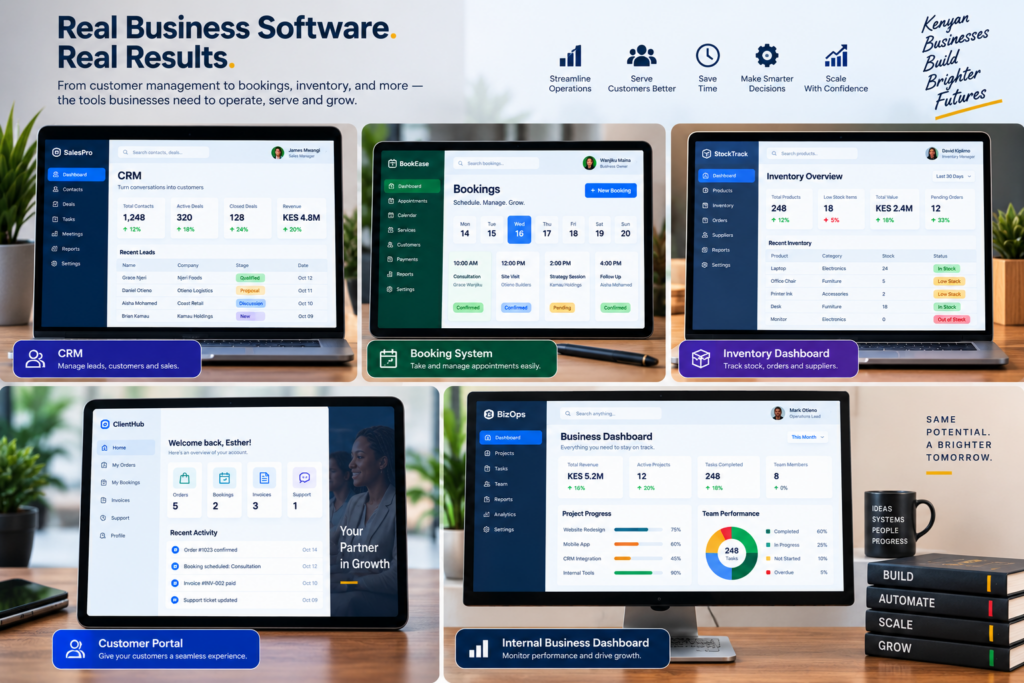
The important point is not that one approach is always better. Match the approach to the problem. A highly specialized system with unusual requirements may call for a traditional development team, while a straightforward customer portal, CRM, booking system, inventory tool, or internal dashboard may be suitable for a modern AI-powered platform.
| Approach | Best When | What to Check |
|---|---|---|
| Development company | You need a highly customized or complex solution. | Experience, delivery process, support, ownership, and total cost. |
| Individual developer | The project is smaller or you already have someone managing it. | Availability, testing, security, maintenance, and continuity. |
| AI software-building platform | You need to build a practical application quickly or validate an idea. | Capabilities, customization, data handling, scalability, and support. |
For example, Ndovesha can help businesses create web apps around practical needs such as customer portals, CRM systems, booking systems, inventory management, internal dashboards, school management systems, and SaaS platforms. You can also explore its FAQ to understand more about how the platform and its AI agents work.
Have a business problem that software could solve?
Explore Ndovesha and see how businesses can create practical web apps around their real needs.Learn more
Frequently Asked Questions
How do I choose a software company in Kenya?
Start by identifying the business problem you want to solve. Then compare providers based on relevant experience, previous work, communication, pricing, timelines, support, security, reviews, and long-term fit. The right company should understand your business rather than simply sell you a list of features.
How do I know if a software company is good?
Look for clear communication, relevant previous work, genuine customer feedback, realistic timelines, transparent pricing, good support, and a strong understanding of your business problem. A good provider should also be comfortable answering difficult questions before you sign.
What should I ask a software developer before hiring them?
Ask about similar projects, the proposed solution, timelines, costs, ownership, security, support, maintenance, and what happens if your requirements change. Asking these questions makes how to choose a software developer much easier for a non-technical business owner.
What software can a small business build?
A small business can build many different types of software depending on its needs, including booking systems, customer portals, CRM systems, inventory systems, internal dashboards, school management systems, websites, and SaaS platforms.
Is custom software worth it for a small business?
It can be, especially when existing tools do not fit the way your business operates or when manual processes are creating significant costs and delays. The important question is whether the expected business value justifies the investment.
Should I choose the cheapest software company?
Not necessarily. Price should be compared with the scope of work, quality, experience, support, timeline, and long-term value. A cheaper project that does not solve the problem can become more expensive in the long run.
Before You Sign: Make the Decision About More Than Price
By this point, you should be able to compare providers on more than a quotation. Look at the complete picture: how well they understand the problem, how clearly they define the work, what evidence they have delivered before, how they communicate, what happens after launch, and whether the relationship still makes sense if your requirements change.
A useful final test is to imagine that the project is already six months old. Your team is using the software every day, customers are interacting with it, and you need a small change. Would you still feel confident calling this provider? If the answer is yes, you are probably evaluating the right things.
Final Checklist Before You Choose
Before you make the final decision, use this simple checklist:
- Problem: Have we clearly identified what we want to solve?
- Experience: Has the provider built something relevant?
- Work: Have we reviewed real examples?
- Communication: Can they explain the project clearly?
- Price: Do we understand exactly what is included?
- Timeline: Do we have realistic milestones?
- Support: Do we know who will help us after launch?
- Security: Do we understand how our information will be protected?
- Reputation: Have we checked reviews and previous customers?
- Future: Can the solution and provider grow with us?
If you can answer these questions confidently, you are in a much stronger position to choose a provider. with confidence
Conclusion
Choosing among the many software companies in Kenya does not need to be a confusing technical exercise. It is a business decision that should start with a simple question: What problem are we trying to solve?
From there, follow the buyer journey: Problem → Research → Define Need → Compare Options → Validate → Decide → Build → Improve. This approach keeps the focus on the outcome instead of getting distracted by technical language or impressive-looking features.
At the same time, think about the people who will experience the software. Your customer journey — Discover → Enquire → Onboard → Engage → Transact → Support → Retain → Advocate — can show you where software can make the relationship with your customers easier and more valuable.
The best software provider is therefore not simply the one that can build something. It is the one that understands why you need it, helps you choose a sensible approach, communicates clearly, delivers a solution people can actually use, and remains capable of helping you improve it as your business changes.
Whether you are comparing development companies, individual developers, or newer software-building options, take the time to ask the right questions before you decide.
The right software can become more than another business expense. Done properly, it can become part of how your business operates, how your team works, and how your customers experience your brand.