
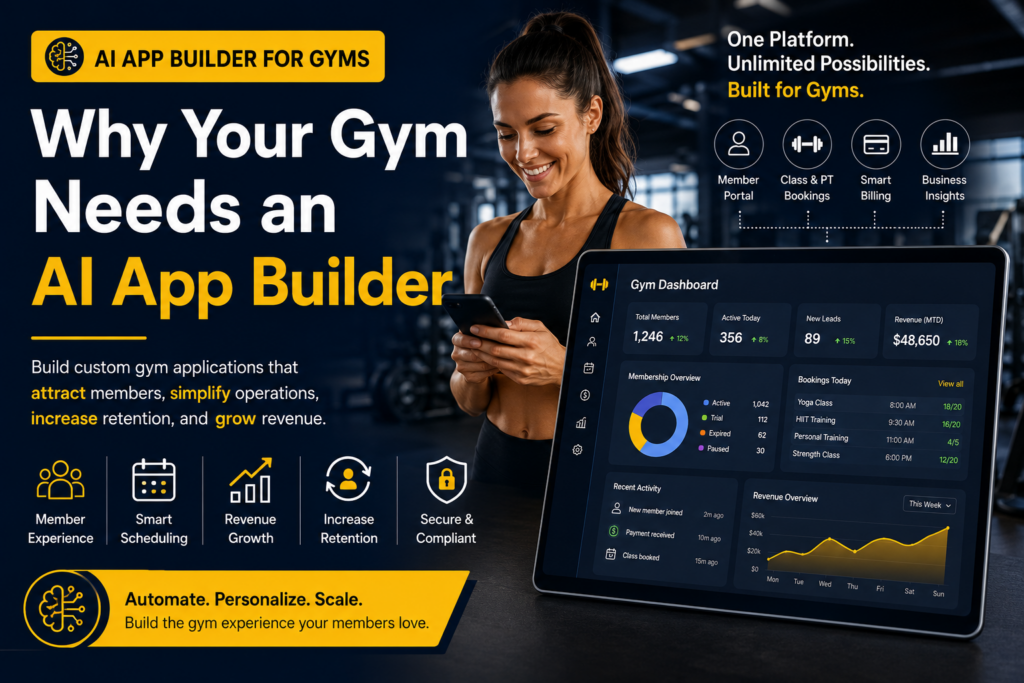
Your Gym Runs on More Than Memberships. Build the Software Around It.
Explore how gyms can use AI application builders to create member portals, gym CRMs, booking systems, trainer dashboards, renewal workflows, and the software behind a better member experience.
⏱ 25 min read
Running a great gym is about far more than having good equipment and a full timetable. Behind every successful membership is a system: how someone discovers you, makes an enquiry, books a trial, joins, gets onboarded, attends classes, works with a trainer, asks for help, and eventually decides whether to renew.
When those steps are scattered across spreadsheets, booking tools, messaging apps, calendars, and separate dashboards, the business can start feeling harder to run than it should.
That is why AI app builders for gyms are becoming an interesting option. Instead of asking your business to adapt to another generic system, you can start with the way your gym actually works and build software around it.
Key takeaway
- An AI app builder for gyms can help turn gym-specific workflows into focused applications.
- Potential applications include member portals, gym CRMs, class booking systems, trainer dashboards, renewal workflows, and operations dashboards.
- The best starting point is usually one workflow with obvious friction and a measurable outcome.
- Member data, payment information, permissions, integrations, and security should be considered before deployment.
- The goal is not to replace gym staff. It is to give them better systems for the work that surrounds member experience and growth.
In this article
- Why Gyms Are Reaching the Limits of Disconnected Software
- Why Your Gym Needs an AI App Builder
- What Is an AI App Builder for Gyms?
- How an AI Application Builder Works
- Step-by-Step Guide to Building a Gym Application with Ndovesha AI
- What Can a Gym Build with an AI App Builder?
- A Real-World Example: Building a Gym Member Intake & Onboarding App
- Another Example: Building a Gym Member Portal
- AI App Builder vs Traditional Software Development for Gyms
- Benefits of AI-Powered Application Development for Gyms
- Security and Member Data Matter
- Why Gyms Should Start With One Workflow
- How AI Apps Fit Into a Gym’s Wider Digital Workflow
- Frequently Asked Questions
- Sources & Further Reading
- Conclusion
- The Member Journey Is the Real Product
- What Data Should Your Gym Application Capture?
- The First Workflows Worth Building
- What a Gym Should Ask Before Building an AI App
- Why Digital Fitness Is Becoming More Connected
- Retention Is a Workflow, Not a Campaign
Why Gyms Are Reaching the Limits of Disconnected Software
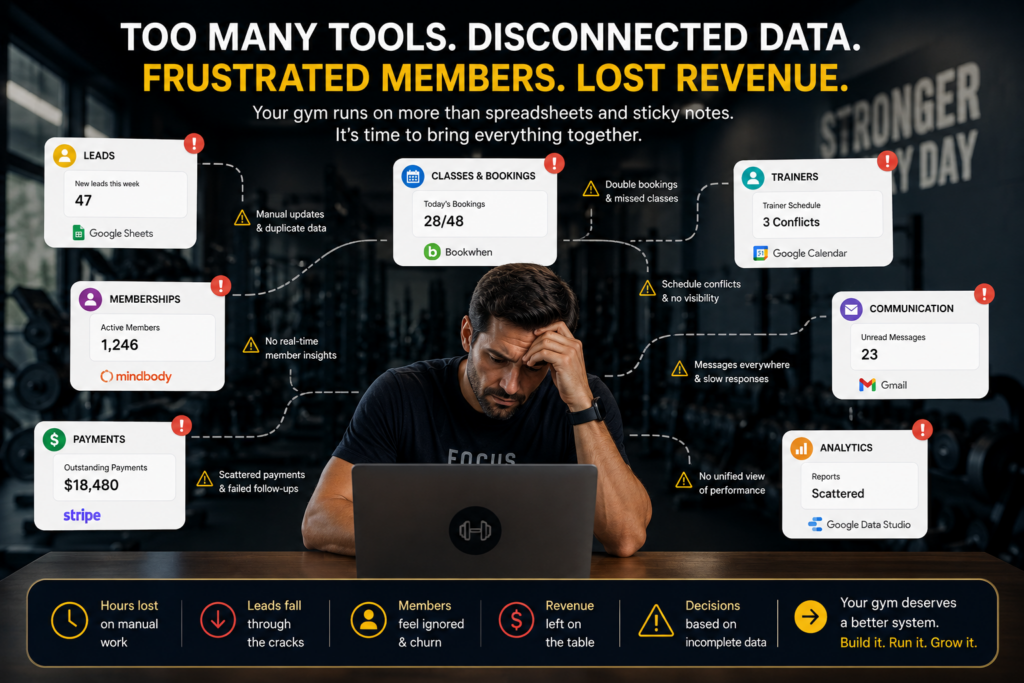
Running a gym looks simple from the outside. Members walk in, trainers coach, classes happen, payments are collected, and the doors close at the end of the day. But anyone running a gym knows the real operation is much more layered. There are memberships to manage, leads to follow up, classes to schedule, trainers to coordinate, renewals to chase, payments to track, equipment to maintain, and members who expect a smooth experience from the moment they discover the gym.
The problem is rarely a lack of software. It is usually too many disconnected pieces of software. One system handles memberships. Another handles payments. WhatsApp handles conversations. Instagram brings in leads. Google Sheets may track something important. A calendar manages classes. A trainer may keep a separate list of clients. And the owner is left stitching the whole picture together.
That is where an AI app builder for gyms becomes interesting. Instead of asking a gym to reshape its operations around a generic application, AI makes it possible to start with the gym’s actual workflow and build software around it. The opportunity is not simply to add another app. It is to create a digital operating layer that connects the work happening behind the scenes with the experience members actually see.
Why Your Gym Needs an AI App Builder
A modern gym is not just a place where people exercise. It is a membership business, a service business, a sales business, a community, and often a coaching business at the same time. Each side creates a different workflow. The software that works well for one part of the operation may not solve the others.
An AI app builder gives gym owners another option: build focused applications around the processes that matter most. That could mean a member portal, a lead management system, a class booking experience, a personal-training dashboard, a renewal workflow, or an internal operations app.
The point is not to replace every system a gym already uses. It is to fill the gaps between them. If your team repeatedly performs the same manual steps, if members keep asking for the same information, or if owners spend too much time piecing together operational data, there may be an application worth building.
There is also a growth argument. A small gym can survive on memory, spreadsheets, group chats, and manual follow-ups for a while. As membership grows, that approach becomes harder to maintain. The business needs processes that are visible, repeatable, and easier for the team to operate consistently.
What Is an AI App Builder for Gyms?
An AI app builder is a platform that uses AI-assisted development to help turn business requirements into working applications. Instead of beginning with a technical specification, a gym can begin with a plain-language description of what it wants the application to do.
For example: “Build a member portal where members can view their membership status, book classes, see upcoming sessions, receive gym announcements, and request support.” That is a business requirement. An AI application builder can help turn that requirement into a starting application that can then be reviewed, customised, tested, and refined.
The gym still decides how the business should work. AI does not know your membership rules, class capacity, trainer schedules, pricing structure, or customer-service policies automatically. The value is in shortening the distance between “this is how we want the gym to work” and “here is a working application that supports it.”
That makes the technology especially interesting for gyms with workflows that are too specific for generic software but not large enough to justify a massive custom technology project. For a broader introduction, see our AI app builder guide.
How an AI Application Builder Works
The process is easier when you think about it as a series of business decisions rather than a technical exercise.
1. Define the outcome: Start with what should improve. Do you want more trial members to convert? Fewer missed classes? Better renewal visibility? Faster responses to member requests?
2. Describe the workflow: Explain who uses the application, what information it needs, what happens at each stage, and what should happen next.
3. Build the application: Start from a prompt, template, or application pattern, then shape the screens, fields, records, roles, and navigation around the gym.
4. Add automation: Introduce appropriate reminders, notifications, assignments, status changes, and routing.
5. Test and deploy: Use realistic member, trainer, manager, and admin scenarios before making the application part of everyday operations.
The quality of the result depends heavily on the quality of the brief. “Build me a gym app” leaves too much unanswered. “Build a member retention dashboard that shows active members, membership expiry dates, attendance trends, last contact, assigned trainer, and renewal status” gives the application a much clearer job.
Step-by-Step Guide to Building a Gym Application with Ndovesha AI
The smartest way to start is not to build the biggest application. Start with one workflow that matters to the business, build it, test it with the people who use it, and then expand.
Step 1 — Sign Up: Create your Ndovesha AI workspace and establish the environment in which the application will be built.
Step 2 — Choose an Application Pattern: Start with a customer portal, CRM, booking system, internal dashboard, or another application pattern that matches the gym’s need.
Step 3 — Describe the Gym Workflow: Define members, trainers, classes, plans, payments, leads, appointments, permissions, and the actions each user needs to take.
Step 4 — Customize and Automate: Shape the interface around the gym’s brand and workflow, then add appropriate reminders, notifications, assignments, and status changes.
Step 5 — Test and Deploy: Test the application with realistic scenarios: a new lead, a trial member, an expiring membership, a cancelled class, a trainer assignment, and a member support request.
The goal is a useful first version, not a perfect theoretical system. Real usage will reveal what should be simplified, added, removed, or automated next.
What Can a Gym Build with an AI App Builder?
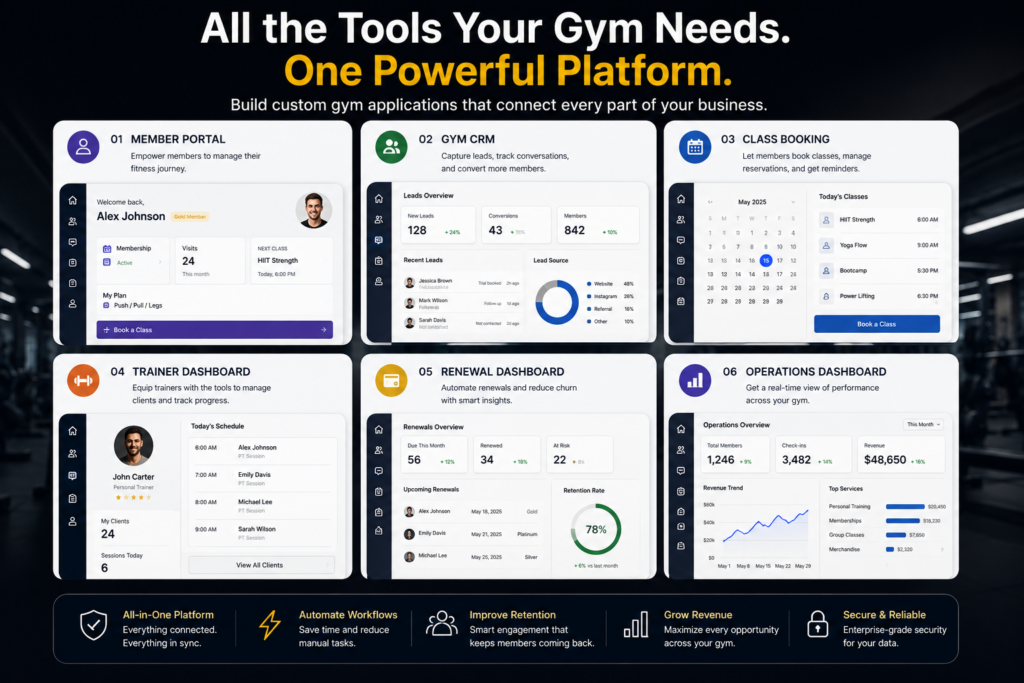
The most valuable applications are usually the ones closest to revenue, member experience, and daily operations. Here are some of the strongest possibilities.
Member Portal: Give members one place to view membership information, upcoming classes, bookings, announcements, support requests, and other approved information.
Gym CRM: Manage leads, trial members, consultations, follow-ups, membership status, and conversion activity in a workflow designed around the gym’s sales process.
Class Booking Application: Let members view schedules, reserve spaces, manage bookings, and receive relevant updates while giving staff visibility into class demand.
Personal Training Dashboard: Help trainers manage assigned clients, sessions, notes, goals, schedules, and follow-up tasks in one focused workspace.
Membership Renewal Dashboard: Surface upcoming expiries, renewal status, recent activity, follow-up ownership, and members who may need attention.
Trial-to-Member Workflow: Track a prospect from first enquiry to trial session, follow-up, offer, conversion, and onboarding.
Gym Operations Dashboard: Give owners and managers a high-level view of memberships, attendance, classes, leads, renewals, and operational tasks.
Equipment and Maintenance Tracker: Track equipment, maintenance requests, service dates, issues, ownership, and resolution status.
Internal Staff App: Build focused workflows for shift schedules, leave requests, internal announcements, tasks, incidents, stock requests, or facility checks.
A Real-World Example: Building a Gym Member Intake & Onboarding App
Imagine someone sees your gym on Instagram, clicks through to your website, and wants to join. They submit an enquiry. What happens next?
In many gyms, the answer is a mixture of email, WhatsApp, phone calls, spreadsheets, and someone’s memory. A staff member responds, schedules a visit, records the prospect somewhere, remembers to follow up, and eventually tries to convert the person into a member.
A dedicated intake and onboarding application can make that journey much more deliberate. The prospect submits their details, chooses their interest or goal, selects a preferred visit or consultation time, and enters the workflow. Staff can see who owns the enquiry, what stage it is in, and what action is due next.
Once the person joins, the same workflow can move into onboarding: membership activated, welcome information sent, orientation scheduled, trainer assigned if appropriate, and the member introduced to the next step.
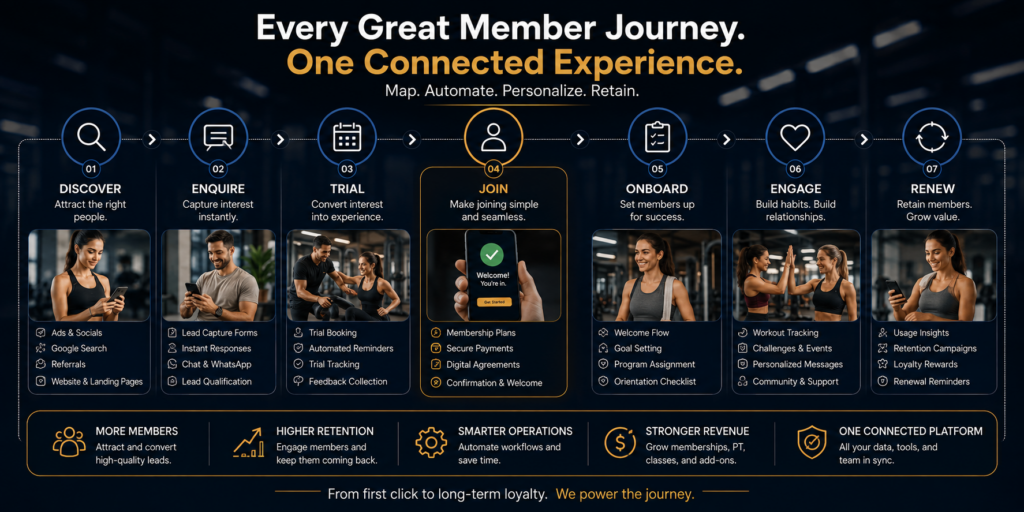
The important part is the continuity. The lead should not feel like one record in a sales spreadsheet and then become an entirely separate problem after payment. The experience can be designed as one journey: discover → enquire → trial → join → onboard → engage → renew.
That is the kind of workflow an AI app builder can help a gym turn into software.
Another Example: Building a Gym Member Portal
A member portal is one of the clearest examples because it sits directly on the customer side of the business.
Instead of members asking staff the same questions repeatedly, the portal can provide a clear place for approved information: membership status, upcoming bookings, class schedules, trainer information, gym announcements, support requests, and other useful resources.
The experience should feel simple. Members should not need to understand how the gym’s back office works. They should simply be able to answer questions like: “When is my class?” “Is my membership active?” “What have I booked?” “How do I request help?”
For the gym, the benefit is equally practical. Staff have a more structured view of member activity and requests, while the business gains a digital channel it controls rather than relying entirely on fragmented conversations.
AI App Builder vs Traditional Software Development for Gyms
An AI app builder is not automatically better than traditional software development. The right choice depends on the complexity, scale, security requirements, integrations, and long-term ambitions of the application.
For many gym-specific workflows, however, the ability to prototype and iterate quickly can be valuable. A gym may not know exactly what its ideal member portal or retention dashboard should look like until staff and members have used the first version.
| Criteria | AI App Builder | Traditional Development |
|---|---|---|
| Starting point | Business requirements, prompts, templates, and workflows | Detailed technical and product specifications |
| Speed | Fast prototyping and iteration | Longer development cycles for many projects |
| Customization | Flexible within platform capabilities | Very high control over implementation |
| Best fit | Focused gym applications and workflow tools | Highly specialised or deeply technical systems |
| Iteration | Business teams can participate more directly | Changes typically require technical implementation |
The practical question is simple: what does the gym need to build, how quickly does it need to learn, and how much technical control does the application require? A focused member workflow may be a strong candidate for an AI app builder, while a complex platform with unusual infrastructure or integration requirements may call for deeper engineering.
Benefits of AI-Powered Application Development for Gyms
Better member experience: Give members a clearer digital journey from enquiry and onboarding through bookings, communication, support, and renewal.
Less administrative friction: Reduce the small repetitive tasks that consume staff time: copying information, checking lists, sending routine reminders, and chasing updates.
Better lead follow-up: Give the sales team visibility into who has enquired, who has attended a trial, who needs a follow-up, and what happens next.
Stronger retention visibility: Bring membership expiry, attendance, engagement, and follow-up information into a more useful operational view.
Faster experimentation: Test a new workflow or member experience without treating every idea as a huge technology project.
More adaptable software: As the gym changes its membership model, class structure, services, or customer journey, the application can evolve with the business.
Better management decisions: Structured operational information gives owners a clearer picture of what is happening across sales, memberships, classes, and member experience.
A clearer view of the member journey: One of the most useful things software can do is connect moments that are often treated separately. A lead is not just a lead. They may become a trial visitor, then a new member, then a regular attendee, then a personal-training client, and eventually a renewal decision. When those stages are visible as one journey, the team can respond more intelligently.
Less dependence on memory: Great staff can remember a surprising amount. But a growing business should not depend on someone remembering every follow-up, missed booking, expiring membership, or unresolved request. A good application turns important next steps into visible work rather than private reminders.
A better owner experience: Owners often become the human integration layer between different parts of the gym. They answer questions, check numbers, chase staff, review leads, and investigate problems. A focused operational application can reduce some of that coordination burden by putting the right information in one place.
A more consistent brand experience: Software is also part of the brand. A polished member portal, clear onboarding journey, easy booking process, and responsive support workflow can make a gym feel more organised and intentional. The application does not replace the energy of the physical gym; it extends that experience digitally.
Security and Member Data Matter
Gyms still handle information that deserves careful treatment: contact details, membership records, payment-related information, attendance history, communications, and sometimes health or fitness information supplied by members.
That means an AI app builder should be evaluated on more than how quickly it produces an attractive interface. Gym owners should understand authentication, user permissions, data storage, backups, integrations, logging, and who can access member information.
If an application handles health-related or sensitive member information, the bar should be even higher. The gym should know what data is collected, why it is collected, where it is stored, who can access it, how long it is retained, and how it can be removed or corrected where appropriate.
AI also does not remove the need for governance. A gym should decide which information can be used with AI-enabled features, which workflows require human review, and how staff accounts and permissions are managed.
The principle is simple: build for convenience, but design for trust. A great member experience is not much of an advantage if the underlying handling of member information is careless.
Why Gyms Should Start With One Workflow
The temptation with new technology is to build everything: member app, CRM, booking system, trainer dashboard, analytics, payments, marketing, support, and operations. That sounds impressive. It is also a good way to create unnecessary complexity.
A better starting point is one workflow where the friction is obvious and the business outcome is easy to measure.
Ask: Where are we losing leads? Where do staff spend the most repetitive time? What do members repeatedly ask us? Which process depends too much on someone’s memory? Where does information disappear between one team member and another?
If the answer is membership renewals, build the renewal workflow. If it is lead follow-up, build the sales workflow. If it is member experience, build the portal. If it is trainer coordination, build the trainer dashboard.
It helps to rank potential workflows using three simple questions: How often does this happen? How much time does it consume? What happens when it goes wrong? A process that happens hundreds of times a month, consumes staff attention, and directly affects revenue or member satisfaction is usually a better first candidate than an occasional administrative task.
You can also define one success measure before building. For a lead workflow, it might be response time or trial-to-membership conversion. For a booking application, it might be booking completion or fewer manual scheduling requests. For renewals, it might be the percentage of upcoming expiries with a documented follow-up. A clear measure keeps the project grounded in business value.
Once the first application works, look for adjacent workflows that naturally connect to it. A lead system can connect to onboarding. Onboarding can connect to a member portal. The portal can connect to bookings and support. Over time, the gym can build a more connected digital operating environment one useful application at a time.
How AI Apps Fit Into a Gym’s Wider Digital Workflow
A gym’s digital experience starts long before a member walks through the door. Someone may discover the gym through social media, search, a referral, an advert, or a local event. They then visit the website, make an enquiry, book a trial, attend a session, join, and begin their membership journey.
That journey creates a useful opportunity for connected applications. Marketing can generate the lead. An intake application can structure it. A CRM can track the relationship. An onboarding workflow can guide the new member. A portal can support the ongoing experience. A renewal dashboard can help the team stay ahead of expiries.
The goal is not to force everything into one giant application. It is to make each part of the journey clearer and more connected.
This is where AI Workers can become part of a wider digital operating model. Ndovesha AI can support web applications alongside other digital capabilities, giving a gym the option to think beyond individual tools and toward a more connected AI workforce.
The Member Journey Is the Real Product
A gym can have great equipment, excellent trainers, and a beautiful facility and still lose members through a frustrating experience. The moments between the workouts matter: how quickly someone gets a response after enquiring, how easy it is to book a class, whether a new member knows what to do next, how reminders are handled, and what happens when someone stops showing up.
That is why a gym management app should not be thought of as a database with a login page. It should support the member journey from first contact to long-term engagement. A well-designed fitness app builder can help a gym connect those moments into one coherent experience.
Think of the journey this way:
- Discover: A prospect finds the gym and requests information.
- Join: The prospect chooses a membership, completes registration, and receives onboarding information.
- Activate: The new member books a first session, joins a class, or meets a trainer.
- Engage: The gym sends useful reminders, tracks participation, and makes it easier to stay involved.
- Retain: Staff can identify members who may need support before disengagement becomes cancellation.
The point is not to automate every human interaction. It is to make the important interactions easier to manage so staff can spend more time on the moments where personal attention actually matters.
What Data Should Your Gym Application Capture?
More data is not automatically better. The better question is: what information helps the team make a better decision?
A useful gym CRM software or member management application might capture information such as:
- Membership type and status
- Join date and renewal date
- Class bookings and attendance
- Personal training sessions
- Lead source and enquiry history
- Member preferences and communication status
- Outstanding actions or follow-ups
- Cancellation requests and reasons
Once those records are structured, the gym can build dashboards around questions managers actually care about. How many new leads are waiting for a response? Which classes are consistently full? Which members have stopped attending? Which memberships are approaching renewal? Where are staff spending the most administrative time?
This is where an AI fitness app can become more than a convenience. It can turn scattered operational information into a clearer picture of what is happening inside the business.
Custom gym management software should transcend basic membership tracking to unify scheduling, revenue streams, and CRM into a cohesive ecosystem. Key development areas include real-time resource allocation, dynamic billing for diverse revenue streams, and automated retention triggers based on member behavior. For more details, visit the guide at GymMaster.
The First Workflows Worth Building
Not every gym needs a giant all-in-one platform on day one. A smarter approach is to identify the workflow where better software would have the most immediate impact.
For many gyms, that might be member onboarding. A new member joins, receives the welcome message, chooses an orientation slot, completes an assessment, meets a trainer, and gets introduced to the facilities. A simple application can make that journey visible to both the member and the team.
For another gym, the priority might be lead follow-up. New enquiries can enter a pipeline, receive the appropriate next step, and remain visible until someone has actually followed up. The goal is not to send more messages. It is to prevent good opportunities from disappearing into an inbox.
For a growing facility, it might be retention and re-engagement. Attendance patterns can be reviewed alongside membership status so staff can decide when a personal check-in or a useful reminder makes sense. Technology does not make the relationship for the gym; it helps the team notice where a relationship may need attention.
What a Gym Should Ask Before Building an AI App
Before you start building, ask a few uncomfortable but useful questions:
- Where are we losing time? Look for repeated admin work, manual data entry, and constant follow-up.
- Where are members experiencing friction? Booking, onboarding, communication, payments, and access are good places to investigate.
- What information do managers wish they had in one place? That answer often reveals the right dashboard or application.
- What should remain human? Coaching, relationship building, community, and important conversations should not be treated as automation problems by default.
- What is the smallest useful first version? A focused application is easier to test, improve, and justify.
This approach also makes an AI app builder for gyms easier to evaluate. You can judge the platform against a real business requirement instead of judging it by how impressive the demo looks.
Why Digital Fitness Is Becoming More Connected
The fitness industry is increasingly comfortable with technology that connects the physical gym experience with digital tools. ACSM’s 2026 fitness trends place wearable technology at number one and mobile exercise apps among the leading trends, reflecting a market where members are already familiar with digital tools around their workouts. Read ACSM’s 2026 fitness trends for the full context.
That matters for gym owners because the member relationship no longer happens only between the front desk and the gym floor. A member may interact with a smartwatch, a mobile fitness app, a booking interface, a digital community, and the gym’s own communication channels before they ever speak to a staff member.
The opportunity is not to collect every possible data point. It is to make the important ones useful. A well-designed AI app platform can sit between those workflows, helping the gym organise information and deliver the right experience without adding another layer of unnecessary complexity.
Retention Is a Workflow, Not a Campaign
Gym retention is often discussed as if there is a single message, offer, or promotion that solves churn. In reality, retention is usually the result of many small experiences adding up over time.
The Health & Fitness Association’s 2025 benchmarking report reported an average member retention rate of 66.4% among participating operators. That number is useful not because every gym should compare itself directly to the benchmark, but because it reinforces how important retention is as an operating metric. See the HFA 2025 Fitness Industry Benchmarking Report.
A better question for a gym owner is: what happens before a member leaves? Do they stop attending? Stop booking classes? Ignore messages? Miss renewals? Complain about a process? A focused application can help the team see those signals and decide where a human intervention might be useful.
This is where an AI member management system can be valuable. It can help organise the workflow around retention without pretending that software itself creates loyalty.
Frequently Asked Questions
What is an AI app builder for gyms?
An AI app builder for gyms is a platform that uses AI-assisted development to help create applications around gym workflows, such as member portals, lead management, class booking, trainer dashboards, renewals, and operations.
Can a gym build a member portal with AI?
Yes. A gym can use an AI application builder to create a portal around its member journey, including approved membership information, bookings, class schedules, announcements, support requests, and other useful features.
Can AI build a CRM for a gym?
AI-assisted application development can help create a gym CRM for leads, trials, follow-ups, membership status, and sales workflows. The exact design should reflect how the gym actually acquires and converts members.
Can gyms build booking applications with AI?
Yes. A booking workflow can be designed around classes, sessions, capacity, trainer availability, reservations, cancellations, and notifications. More complex scheduling or payment requirements may require additional integrations.
Is AI-built gym software secure?
Security depends on the platform, architecture, configuration, integrations, and controls used. Gym owners should evaluate authentication, permissions, data handling, backups, logging, and governance before using an application with sensitive member information.
Does an AI app builder replace gym staff?
No. The purpose is to support the team’s workflows and reduce repetitive administrative work. Trainers, sales teams, front-desk staff, managers, and owners remain responsible for the human interactions and decisions that make a gym valuable.
Can small gyms use AI app builders?
Yes. Smaller gyms can start with one focused workflow, prove the value, and expand gradually. That can be more practical than trying to build a complete digital platform from day one.
Sources & Further Reading
- CDC Physical Activity — A useful public-health reference for understanding physical activity and the broader context in which fitness businesses operate.
- American College of Sports Medicine — Resources and professional guidance across exercise science and the fitness industry.
- Health & Fitness Association — Industry resources and insights for health and fitness businesses.
- World Health Organization — Physical Activity — Global background on physical activity and health.
- Forbes — Essential Elements of a Successful Blog Post — Useful context on clear value, structure, and calls to action.
- LCN — Characteristics of Great Blog Content — Guidance on readable, useful, engaging content.
- Health & Fitness Association — How Gyms Are Using Member Data to Increase Retention — Industry perspective on data, technology, and member retention.
- ACSM Fitness Trends — Ongoing research and industry trends for fitness professionals and operators.
Build Software Around the Way Your Gym Works
Start with one gym workflow. Turn it into a working application. Then improve it with the people who use it every day.BUILD YOUR GYM APPLICATION
Conclusion
Your gym already has a workflow. Leads come in. Trials happen. Members join. Classes fill up. Trainers coach. Renewals approach. Questions arrive. The opportunity is to turn the parts of that journey that create friction into software that actually reflects how the gym operates.
An AI app builder for gyms gives owners another way to approach that challenge. Start with one meaningful workflow. Build a focused application. Test it with staff and members. Learn what works. Then connect the next workflow.
The goal is not to add technology because AI is fashionable. It is to build a better operating system around the business you already have — one that makes the member experience smoother, gives the team better visibility, and gives the owner more room to focus on growth.
Your gym is more than a membership database. Your software should be more than one, too.