
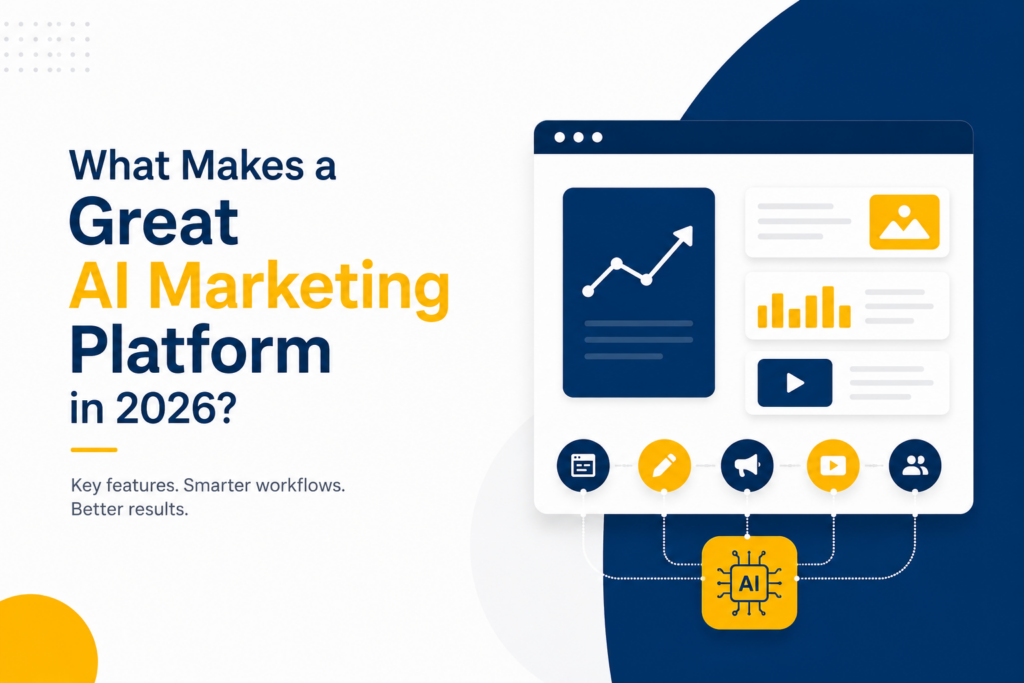
What Makes a Great AI Marketing Platform in 2026?
In 2026, the question is no longer whether businesses should use AI. The real question is whether they are using the right AI marketing platform. Over the last few years, artificial intelligence has moved from an experimental technology to a core business capability. Marketing teams now use AI to write content, generate ads, create videos, design websites, analyse customer behaviour, and automate campaigns.
Yet despite this rapid adoption, many businesses are finding themselves overwhelmed. There are thousands of AI marketing tools available. Every week seems to bring a new platform promising faster content creation, better automation, or smarter campaigns. The challenge is no longer finding AI — the challenge is choosing the right AI marketing platform. Much of this acceleration has been driven by advances in the latest AI research, which continue to improve content generation, automation, and reasoning capabilities.
The businesses seeing the biggest gains from AI are not necessarily using the most tools. Instead, they are using platforms that bring multiple capabilities together into a single ecosystem designed for execution, productivity, and growth. This guide explores what separates great AI marketing platforms from ordinary AI tools — and how businesses can choose the right solution for the future.
TL;DR
A great AI marketing platform does more than generate content. The best platforms help businesses:
- Build websites and landing pages quickly without design teams
- Create marketing content at scale across every channel
- Generate ad creatives and videos without production bottlenecks
- Automate workflows and collaborate efficiently across teams
In 2026, businesses are shifting away from disconnected AI tools and toward unified platforms that help them execute faster and achieve measurable business outcomes.
What Is an AI Marketing Platform?
AI Tools vs AI Assistants vs AI Platforms
Not all AI products are created equal. Understanding the difference between tools, assistants, and platforms helps businesses make better purchasing decisions.
| Type | Purpose | Example Use |
|---|---|---|
| AI Tool | Performs one specific task | Generate a blog article |
| AI Assistant | Helps answer questions and complete tasks | Draft campaign ideas |
| AI Platform | Combines multiple marketing functions | Build websites, create ads, generate content, automate workflows |
Many businesses start with individual AI tools. However, as marketing operations become more complex, managing multiple tools creates friction. That is where platforms become valuable.
Why Platforms Are Becoming the New Standard
Modern businesses require faster execution, better coordination, consistent branding, lower costs, and scalable systems. Platforms provide all of these advantages by bringing multiple capabilities together under one roof — eliminating the workflow fragmentation that slows most marketing teams down.
Why Businesses Need AI Marketing Platforms
According to research on AI adoption in business from McKinsey, organisations are increasingly investing in AI to improve productivity and operational efficiency. The practical benefits break down across five key dimensions.
Speed
A campaign that takes three weeks to launch manually can be created in hours using an AI-powered platform. Speed has become a direct competitive advantage — and how one agency landed its first 5 clients in just 48 hours is a powerful example of what faster execution makes possible.
Scalability
A platform enables teams to increase output without proportionally increasing headcount. More campaigns, more content, more experiments, more revenue opportunities — without dramatically increasing costs.
Consistency
Platforms help standardise brand messaging, visual identity, campaign assets, and customer experiences across every channel — something that is extremely difficult to maintain across multiple disconnected tools.
Productivity
Marketing professionals spend significant time switching between tools. AI marketing platforms eliminate this inefficiency by letting teams operate from one environment rather than juggling design software, copywriting tools, website builders, and video editors separately.
Lower Operating Costs
Consolidating tools often reduces software expenses substantially. Businesses can replace multiple subscriptions with a single platform that delivers broader functionality at a lower total cost.
Better Outcomes
Platforms are built around marketing execution — not just content generation. That focus on outcomes means every feature drives toward leads, conversions, and revenue rather than simply producing more content.
The 10 Characteristics of a Great AI Marketing Platform
1. Easy to Use
The best AI marketing platform is not necessarily the most powerful — it is the one people actually use. Great platforms prioritise clean interfaces, minimal learning curves, guided workflows, and fast onboarding. Technology should simplify work, not complicate it.
2. High-Quality Outputs
Output quality remains one of the most important evaluation criteria. Businesses need accurate content, professional visuals, strong copywriting, and brand consistency. Poor output quality creates more editing work and reduces the productivity gains AI is supposed to deliver.
3. Website Generation
In 2026, website creation is becoming a core capability of leading AI marketing platforms. A great platform should help businesses generate full websites, landing pages, lead generation pages, and product pages quickly. Websites remain the foundation of digital marketing — without them, most campaigns have nowhere to convert traffic.
4. Content Creation
Content remains one of the biggest drivers of growth. AI marketing platforms should support blog posts, social media content, product descriptions, email campaigns, and SEO content at scale. Many of today’s most effective strategies align with established AI marketing best practices focused on efficiency, personalisation, and scale. For deeper insight, explore this guide to AI in content marketing. The best platforms also help teams plan a month of content using AI in a fraction of the time traditional planning methods require.
5. Ad Creative Generation
Advertising is becoming increasingly visual. Great AI marketing software should help generate display ads, social media ads, banner creatives, and campaign visuals — dramatically reducing design bottlenecks. Businesses can now create campaign posters using AI without relying on traditional design processes.
6. Video Creation Capabilities
Video continues to dominate digital engagement. Platforms that include AI video generation gain a significant advantage. Businesses increasingly need social videos, product demos, promotional clips, and explainer videos — generated quickly and affordably without hiring production crews.
7. Workflow Automation
AI marketing automation is no longer optional. Modern platforms should automate content publishing, campaign creation, lead nurturing, and asset generation. Businesses that implement proven systems such as the AI workflows every small business should use can eliminate repetitive marketing tasks and focus on growth.
8. Team Collaboration
Marketing is rarely a solo activity. Great platforms support shared workspaces, team access, collaboration workflows, and review processes. This becomes especially important for agencies and growing businesses managing multiple clients or campaigns simultaneously.
9. Scalability
A platform should support growth at every stage — whether a business has one employee, ten, or one hundred. Scalability ensures long-term value and protects the investment businesses make in learning and integrating a platform into their operations.
10. Conversion-Focused Design
Marketing assets should generate measurable outcomes. A great AI-powered marketing platform focuses on leads, conversions, sales, and customer acquisition — not just content production. Every feature should connect to a business result.
Common Problems with AI Tools
While individual AI tools can be useful, many businesses encounter significant challenges when relying on them exclusively.
Tool Overload
Many companies end up using one tool for writing, one for images, one for websites, one for videos, and one for automation. The result is complexity rather than efficiency — more logins, more contexts, more cognitive overhead.
Disconnected Workflows
Moving information between tools slows execution dramatically. Data becomes fragmented, teams lose efficiency, and the promise of AI productivity is undermined by the manual work required to connect everything together.
Inconsistent Outputs
Different tools produce different styles, formats, and quality levels. This creates significant branding challenges — especially for businesses trying to maintain a unified voice and visual identity across channels.
Multiple Subscriptions & Learning Curves
Every new tool requires training, and subscription costs accumulate quickly. Businesses often discover they are paying for overlapping functionality across multiple platforms while their teams struggle to master each one separately.
Standalone AI Tools vs AI Marketing Platforms
| Criteria | Standalone AI Tools | AI Marketing Platforms |
|---|---|---|
| Ease of Use | Moderate | High |
| Productivity | Limited | High |
| Workflow Integration | Low | High |
| Cost Efficiency | Variable | Better Long-Term |
| Scalability | Limited | Strong |
| Team Collaboration | Often Missing | Built-In |
| Business Outcomes | Indirect | Direct |
| Speed to Execution | Moderate | Fast |
Case Study: Why Businesses Are Moving Toward Platforms
Consider two companies launching the same marketing campaign.
Company A — Fragmented Tools
Uses a separate content tool, design tool, video tool, website builder, and automation software. Five subscriptions. Five workflows. Five learning curves. Campaigns take weeks to launch and require significant coordination overhead.
Company B — Unified Platform
Uses a single AI marketing platform. Website creation, content generation, visual design, and campaign assets happen inside one ecosystem. Faster launches, lower costs, better coordination, and higher productivity — with a smaller team.
This is why platforms are increasingly replacing fragmented tool stacks. The efficiency gains are not marginal — they are structural. And for businesses focused on growth, structural efficiency compounds over time.
How Ndovesha AI Fits Into the New Marketing Stack
Many businesses are searching for an AI solution that goes beyond content generation. This is where Ndovesha AI positions itself differently. Rather than focusing on a single marketing task, Ndovesha is designed as an AI marketing platform that helps businesses create and launch marketing assets from one environment.
What Ndovesha AI Covers
Website generation, landing page creation, ad creatives, marketing visuals, social media content, social media videos, branding assets, and blog content — all from a single platform designed for marketing execution.
The Core Value Proposition
Help businesses move from idea to execution faster. Instead of managing multiple disconnected tools, businesses can centralise execution and focus on outcomes. Ndovesha is best described as an AI marketing execution platform built to help businesses launch, market, and scale faster.
The Future of AI Marketing Platforms
Industry analysts tracking marketing technology trends expect AI-powered workflows and automation to become central components of modern marketing operations. The next generation of marketing technology will be defined by four emerging capabilities.
AI Workers
AI workers perform specific marketing functions — content worker, website worker, design worker, SEO worker, advertising worker. Each specialises in a particular outcome and can operate continuously without human intervention on routine tasks.
AI Agents
AI agents go beyond task completion. They can make decisions, execute actions, and coordinate workflows with minimal human involvement — acting more like autonomous team members than simple tools.
AI-Powered Teams
Future businesses may operate with smaller human teams supported by AI-powered teams — creating faster execution, lower costs, and greater operational flexibility without sacrificing output quality or campaign sophistication.
Autonomous Marketing Workflows
Eventually, workflows will detect market opportunities, create landing pages, generate ads, launch campaigns, analyse performance, and recommend optimisations — all automatically. Businesses that embrace these systems early will gain a lasting competitive advantage.
How to Choose the Right AI Marketing Platform
When evaluating platforms, ask five questions before making a decision.
Ideas are valuable. Execution is what drives growth. Choose platforms that help you produce assets and launch campaigns — not just platforms that help you brainstorm or draft text.
The best platform simplifies operations. More tools rarely mean better outcomes. If a platform requires you to add more tools around it, it is solving the wrong problem.
Look for platforms that generate websites, landing pages, content, videos, and ads — not just text. Real assets drive real business results.
Time savings should be quantifiable. If a platform does not significantly improve productivity within the first few weeks of adoption, it may not be the right fit.
Choose systems that grow with your business. Scalability matters more than novelty — the best platform for today should still be the right platform when your team and output triple.
Frequently Asked Questions
Key Takeaways
What to Remember
- AI adoption is accelerating worldwide — businesses that move early build compounding advantages
- Platforms are replacing fragmented tool stacks — consolidation drives faster execution and lower costs
- The 10 characteristics of great platforms include usability, quality, website generation, content, ads, video, automation, collaboration, scalability, and conversion focus
- Common tool problems — overload, disconnected workflows, inconsistent outputs, and subscription bloat — are solved by platforms
- AI workers and autonomous workflows will define the next generation of marketing technology
- Evaluate platforms on outcomes, not features — does it help you execute faster and scale more efficiently?
Final Thoughts
The most successful businesses in 2026 will not necessarily use the most AI tools. They will use the right AI marketing platform. As AI continues reshaping marketing, the winners will be organisations that simplify execution, eliminate workflow friction, and scale efficiently — not those with the longest list of software subscriptions.
The best AI marketing platforms do not just generate content. They help businesses execute faster, create better assets, maintain brand consistency, and scale more efficiently than their competitors. That combination — execution speed plus quality at scale — is what defines the new standard in marketing technology.
Browse more marketing resources on the Ndovesha blog to continue building your AI marketing knowledge and discover how an integrated platform approach can transform your business results.
Ready to Build Faster With AI?
Try Ndovesha AI and discover how an AI marketing execution platform can help you create websites, landing pages, marketing content, ad creatives, videos, and branding assets from one place.
Try Ndovesha AI Today